


Why Long-Term Care Planning Matters for Future Healthcare Costs
Why Long-Term Care Planning Matters for Future Healthcare Costs According to the 2025 Milliman Long-Term Care Index, the average 65-year-old faces rou...
One of the most common retirement mistakes affluent households make is not picking the wrong investment. It is making one smart-looking decision without seeing what it quietly changes everywhere else. A well-timed Roth conversion can push Medicare premiums higher. Claiming Social Security a year early can reduce the flexibility you need to manage your tax bracket later. For high-net-worth individuals, the cost of a disconnected decision is rarely visible until it is already locked in.
The strongest retirement planning strategies for high-net-worth individuals in 2026 are not about finding better returns or squeezing out isolated tax wins. They are about coordinating IRA distributions, tax brackets, income timing, investment risk, and estate intentions into one plan before the big choices become hard to reverse. That means connecting your retirement date, Roth conversion window, Social Security timing, withdrawal order, and legacy goals so each decision supports the others. Fortitude Wealth Planners helps individuals and families build exactly that kind of coordinated plan.
Most high-net-worth retirement planning conversations in 2026 start in the wrong place. The first question usually lands on investments or Social Security timing, when it should land on the full income picture: what comes in, what gets taxed, and in what order. Getting that map right before choosing any tactic is what keeps individual decisions from creating problems elsewhere.
These three inputs feed each other. Leave work a year earlier than planned, and your portfolio carries more weight. Spend more in early retirement, and you may be forced to pull from accounts in a sequence that drives up your tax bracket faster than expected. When you test them together, you can see the real tradeoffs before you commit to any one of them.
High-net-worth retirees often have more options than they realize: taxable brokerage accounts, pre-tax IRAs, Roth accounts, pensions, and business income. The problem is that tapping accounts in whatever order feels convenient can push income into higher brackets or trigger Medicare IRMAA surcharges. Sequencing income with intention, not convenience, is where the real after-tax value is protected.
Whether you plan to spend your assets, leave them to children, or direct them to charity changes nearly every withdrawal and conversion decision you make today, not in a general way, but in specific, dollar-level ways. A family that wants to pass a large pre-tax IRA to heirs is also, whether they realize it or not, passing the tax liability embedded in it; a Roth conversion made now can reduce that burden significantly. A family focused on spending down assets faces a different sequencing problem entirely. Bringing those estate intentions into the tax map early, before required minimum distributions begin forcing taxable withdrawals at age 73, means your cash flow and your legacy goals are working from the same set of assumptions, not colliding after the big decisions are already locked in.
For many high-net-worth individuals, the years between their last paycheck and age 73 represent the most valuable planning window they will ever have. Once required minimum distributions begin, the IRS decides how much comes out of your traditional IRA each year whether you need it or not. That forces taxable income onto your return, often at the worst possible time, and leaves far less room to convert on your own terms.
The real question is when to convert, how much, and how each conversion interacts with everything else on your tax return that year. A conversion that looks efficient in isolation can push Social Security benefits into a higher taxable range, trigger Medicare IRMAA surcharges, or crowd out room for capital gains at a preferred rate. According to FPA Roth conversion research, paying conversion taxes from outside cash rather than from the IRA itself tends to produce better outcomes, and the analysis always needs to account for the client's planning horizon, state taxes, and what happens to a surviving spouse who files alone after a death.
That is why IRS Publication 590-B matters here: it is not just a reference document. It is the rulebook that governs what you can and cannot do once RMDs begin. RMDs cannot be rolled back into a Roth account, and post-2017 conversions are irrevocable. Those constraints make the pre-RMD window the right time to model, decide, and act rather than wait and react.
Here is what effective coordination looks like in practice for high-net-worth individuals approaching retirement in 2026:
The math on any single conversion can look compelling. The question is whether it still holds once Medicare IRMAA thresholds, Social Security taxability, your current bracket's upper limit, and your spouse's eventual single-filing status are all in the same model. That is the calculation worth running before you act, and the reason sequencing decisions across accounts and years consistently beats optimizing each one in isolation.
Radial infographic showing the transition from final working years into retirement with concentric rings and labeled spokes for IRA withdrawals, Roth conversions, and required minimum distributions, using muted green accents and simple icons for decision points.
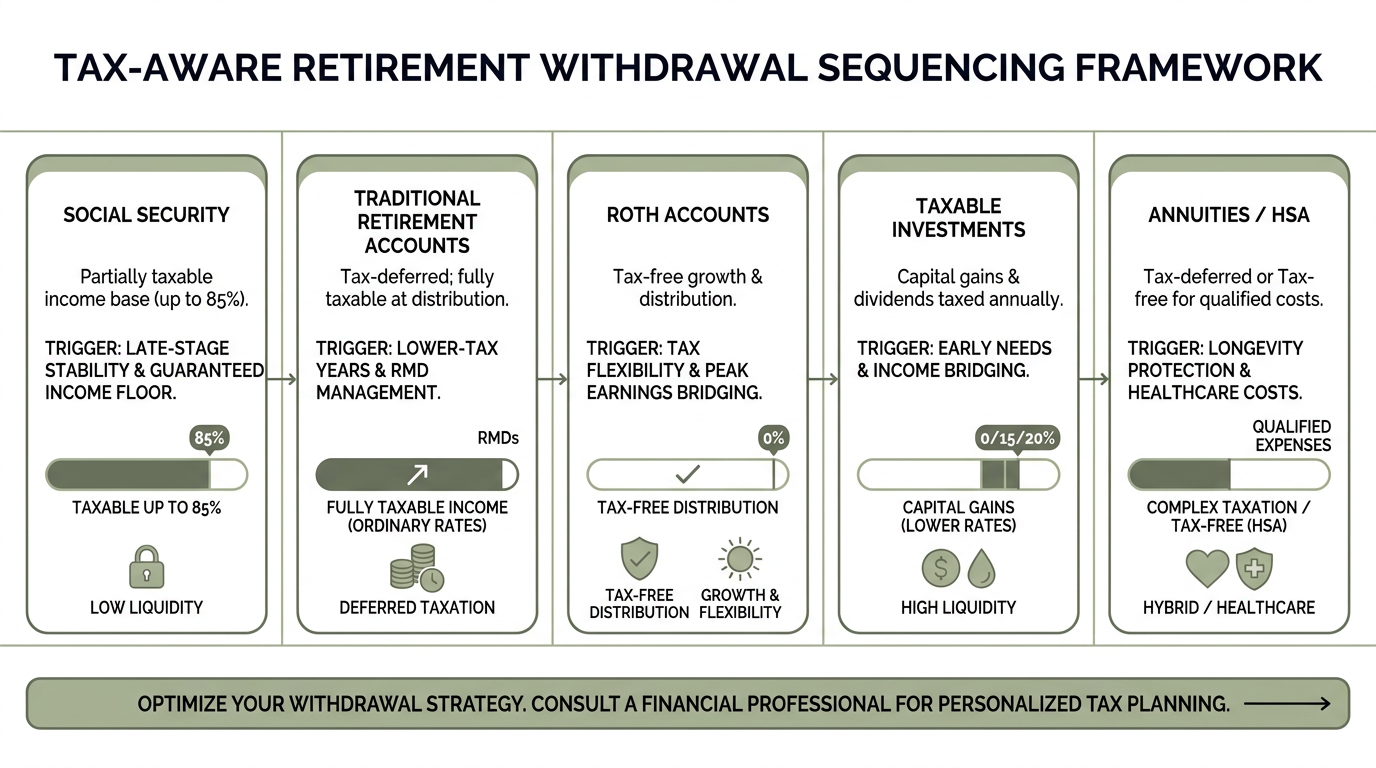
Most high-net-worth retirees have at least three or four sources of income to draw from, and the order in which they tap those sources matters as much as the amounts involved. The 2026 tax brackets are inflation-adjusted, which gives careful planners more room to work within each bracket, but that room disappears quickly if withdrawals from different accounts are not sequenced with intention.
|
Income Source |
Tax Treatment |
Best Use Window |
Planning Tradeoff |
|---|---|---|---|
|
Taxable Brokerage |
Long-term capital gains rates (0%, 15%, 20%); dividends taxed annually |
Early retirement years; large one-time expenses; before RMDs begin |
Selling appreciated assets triggers capital gains; timing relative to other income is important |
|
Traditional IRA / 401(k) |
Ordinary income on all withdrawals; RMDs required beginning at age 73 |
Strategically before Social Security to fill lower brackets; after Roth conversion window closes |
RMDs can push income into higher brackets and trigger Medicare IRMAA surcharges |
|
Roth Accounts |
Tax-free qualified withdrawals; no RMDs during the account owner's lifetime |
High-income years; large expenses; as a legacy asset for heirs |
Conversions are taxed as ordinary income upfront; most valuable when held long enough to outpace the conversion cost |
|
Social Security |
Up to 85% taxable as ordinary income depending on combined income |
Often delayed to age 70 for higher earners to maximize the monthly benefit and reduce early portfolio pressure |
Claiming earlier preserves Roth conversion flexibility; delaying reduces longevity risk but shortens the pre-claim planning window |
Social Security claiming is not just an age decision, and for high-net-worth retirees it should not be treated as one. Delaying to age 70 grows the benefit by roughly 8% per year past full retirement age, but those same pre-claim years are often the best window for Roth conversions since earned income has dropped and RMDs have not yet started. Claiming earlier can make sense if other income is already filling the brackets or if a health situation changes the calculus. A temporary $6,000 senior deduction available from 2025 through 2028 adds another variable worth modeling, particularly for households near the phaseout thresholds. The right answer depends on what the rest of the income picture looks like that year, which is exactly why a year-by-year plan beats a fixed rule.
The closer retirement gets, the more specific the questions become. These answers address the planning decisions that tend to have the biggest long-term impact for affluent households, particularly where tax rules, account types, and life changes intersect.
For high earners, delaying Social Security past full retirement age can increase your benefit by up to 8% per year through age 70, per the Social Security Administration. More importantly, delaying keeps Social Security out of your income picture during years when Roth conversions may be most efficient. The right timing depends on your overall income map, not age alone.
Start by auditing beneficiary designations across retirement accounts, insurance policies, and estate documents. Mismatches between them can quietly undermine a well-intentioned plan even when each piece looks fine on its own. Structures like trusts can then coordinate how assets transfer while preserving flexibility for surviving spouses or heirs. Fortitude's trusts and wealth transfer and tax planning services address exactly this kind of layered coordination.
Yes, and often more than people expect. Widowhood compresses your tax filing status from married to single, which means the same income can push you into a higher bracket almost immediately. Divorce changes Social Security eligibility, for example, a divorced spouse may claim on an ex-spouse's record if the marriage lasted at least 10 years, per AARP spousal benefits. A business sale or large inheritance can create a one-time spike in taxable income that reshapes your entire withdrawal and conversion strategy going forward.
Medicare premiums are income-sensitive. If your income exceeds certain thresholds, you will pay the Income-Related Monthly Adjustment Amount, known as IRMAA, which can add hundreds of dollars per month to your Part B and Part D costs. A Roth conversion or large capital gain in the wrong year can trigger this surcharge. Coordinating income carefully through your retirement planning strategy helps you avoid crossing those lines unintentionally.
What makes retirement planning genuinely difficult for high-net-worth households is not the complexity of any single decision. It is that the decisions are linked, and getting one wrong often narrows your options everywhere else. The Roth conversion sized without checking Medicare IRMAA thresholds trips a surcharge that erases part of the gain. The Social Security claim made at the right age but for the wrong reasons closes off years of efficient conversion space. The withdrawal sequence that made sense in year one locks you into a higher bracket by year five. A coordinated plan, where income, tax strategy, investments, insurance, and estate intentions are built together rather than layered on afterward, is the only structure that catches those tradeoffs before they become permanent.
Fortitude Wealth Planners is built for this kind of coordination across the full picture with retirement income, IRA distributions, tax planning, investments, insurance, and estate intentions connected in one plan rather than handled in separate conversations. We work with individuals and families who want those connections made visible before they commit, not discovered afterward. If you are within a few years of retirement, the pre-RMD window you have right now is the most valuable planning period you will have. Review your retirement options with our team.