


Why Long-Term Care Planning Matters for Future Healthcare Costs
Why Long-Term Care Planning Matters for Future Healthcare Costs According to the 2025 Milliman Long-Term Care Index, the average 65-year-old faces rou...
An IRA withdrawal that looks manageable in isolation can push more of your Social Security benefits into taxable territory, trigger IRMAA surcharges that raise your Medicare premiums two years later, and quietIy shrink what you pass to your family, all from a single number that no one connected to the rest of the plan. Research from the Financial Planning Association found that a coordinated, goals-based planning approach adds the equivalent of roughly 1.65% in annual returns compared to fragmented decision-making. Near retirement, where mistakes are harder to reverse, that gap is the difference between a plan that holds and one that quietly unravels.
Holistic wealth management is not about adding more products to your financial life. It is about making each major decision support the others so a Roth conversion completed before required minimum distributions begin reduces those RMDs, which keeps more Social Security income out of the taxable column, which holds Medicare costs in check, which leaves more room for the estate plan. When IRA distributions, tax planning, insurance, and estate documents are reviewed together, avoidable tax drag and hard-to-reverse mistakes become far easier to catch. Fortitude Wealth Planners builds that kind of coordinated plan so every part of your financial life moves in the same direction.
Creating a retirement income plan that coordinates IRA withdrawals, Social Security, and taxable accounts is less about picking the right accounts and more about sequencing them in an order that keeps taxes manageable year after year. Where your income comes from in any given year shapes your tax bill, your Medicare costs, and how long your savings stay working for you. Getting that sequence right takes a plan built around your full picture, not three separate decisions made independently.
Most people think of withdrawal order as a logistics question: which account do I tap first? It is really a tax question. Drawing from a traditional IRA raises your ordinary income, which can push more of your Social Security benefits into taxable territory. Up to 85% of those benefits become taxable once combined income exceeds certain thresholds. The order you pull income from your accounts determines whether you stay below those lines or cross them.
Social Security claiming is one of the more consequential retirement decisions, partly because it interacts with so many other income sources. SSA rules govern when and how you can file, but the tax and cash flow implications depend on what else is happening in the same year. Claiming early while drawing from a traditional IRA in the same year, for example, can increase taxable income more than expected. Social Security timing is less a benefits question than a tax question with a deadline, and the right answer depends entirely on what else is in your income picture that year.
One consequence that surprises many pre-retirees is how IRA withdrawals or large taxable distributions can affect Medicare premiums two years later through IRMAA surcharges. Medicare uses income reported on your tax return from two years prior to set your Part B and Part D premiums, so a spike in income today can increase healthcare costs well into retirement. A year-by-year income map, built around your spending needs and tax brackets, helps prevent those spikes from showing up as surprises.
Fortitude's retirement planning approach is built around mapping income sources proactively, so spending needs are met without creating friction in the tax picture. That means coordinating Social Security timing, IRA distribution amounts, and taxable account draws in a sequence that fits your household's specific income range and goals. Combined with tax planning and thoughtful investment strategy, this kind of coordination keeps more of what you saved working the way you intended.
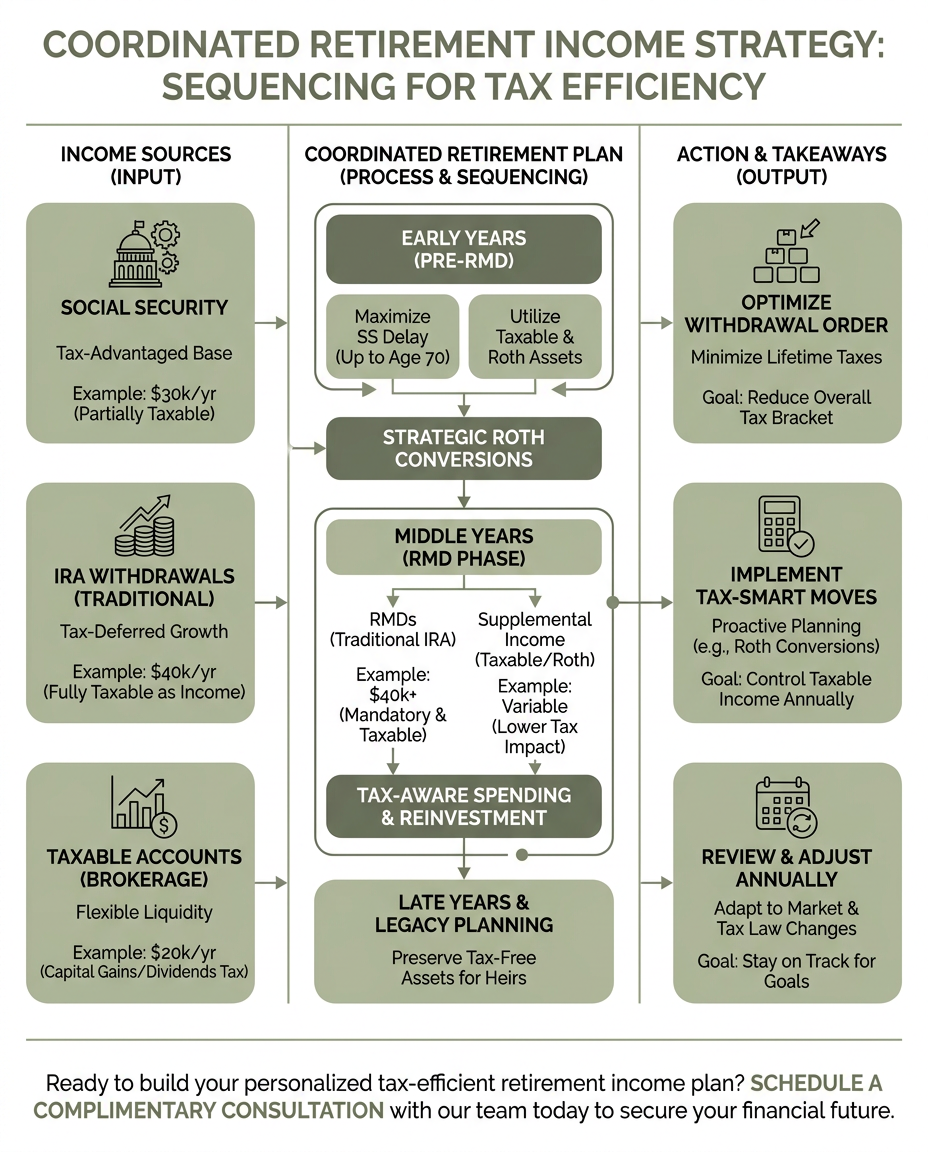
Infographic flowchart showing retirement income sources (Social Security, IRA withdrawals, taxable accounts) feeding into a central coordinated retirement plan with labeled sequencing, tax-aware callouts, and a final action box. Clean flat design with clear arrows, icons, and short labels for quick scanning.
For many people in the gap between leaving work and the start of required minimum distributions, taxable income is lower than it will ever be again. That window is often the best time to consider moving money from a traditional IRA into a Roth, because Roth IRAs carry no required distributions for the original owner and qualified withdrawals come out tax-free. Done thoughtfully, a conversion strategy during those years can reduce the size of future RMDs and ease the tax pressure that builds once they begin. Here is what makes that planning work in practice:
The right approach depends on your full financial picture: your income sources, projected RMD amounts, estate intentions, and how each interacts with your tax situation year by year. Vicki Beam's membership in Ed Slott's Elite IRA Advisor Group shapes how Fortitude approaches this kind of multi-year analysis, because the decisions made in one year quietly narrow or expand the options available in the next.
Investment returns and tax strategy can only do so much if gaps in insurance coverage or outdated estate documents quietly work against the rest of the plan. Insurance planning and estate planning address risks that portfolio performance simply cannot fix, from an unexpected long-term care need to assets passing to the wrong beneficiary because a form was never updated after a life change. The four areas below show where those disconnects tend to appear and what a coordinated review actually checks.
|
Planning Area |
What It Protects |
Common Disconnect |
What A Coordinated Review Checks |
|---|---|---|---|
|
Property & Liability Coverage |
Personal assets from lawsuits, accidents, and property loss |
Coverage limits set years ago that no longer reflect current net worth or lifestyle |
Whether umbrella liability coverage aligns with total assets, and whether home and auto limits have kept pace |
|
Health & Long-Term Care Exposure |
Out-of-pocket costs from illness, disability, or extended care needs |
Assuming Medicare covers long-term care costs, which it largely does not |
Gaps between Medicare coverage and actual care costs, and whether a long-term care policy or self-funding strategy fits the overall plan |
|
Beneficiary Designations |
Who receives retirement accounts, life insurance, and transfer-on-death assets |
Old designations naming an ex-spouse, a deceased relative, or no contingent beneficiary |
That named beneficiaries on every account reflect current wishes and coordinate with the estate plan |
|
Estate Documents |
How assets are managed and transferred if incapacity or death occurs |
Wills, powers of attorney, or trusts that are outdated, missing, or misaligned with retirement accounts |
That wills, healthcare directives, powers of attorney, and any trust structures are current and consistent with how accounts are titled |
A beneficiary form on a retirement account overrides a will, which means even a carefully drafted estate plan can be undone by a designation that was never revisited. Reviewing these four areas together, rather than on separate schedules, is what keeps the protection layer of a retirement plan working alongside the income, tax, and investment decisions built around it. Fortitude's holistic financial planning approach treats insurance and estate documents as part of the same coordinated conversation, not afterthoughts to handle separately.

Infographic showing a four-part protection checklist-insurance, beneficiaries, powers of attorney, and estate documents-arranged around a central financial planning hub with clean icons, short labels, and brand colors for clarity. The layout emphasizes connection between protection steps and the broader financial plan and ends with a short call to action.
The closer you get to retirement, the more specific your questions become. The answers below address situations that come up often for people in the final stretch before leaving work, where one decision can quietly affect several others.
Tax planning reduces the weight of required minimum distributions by shrinking pre-tax balances before mandatory withdrawals begin, typically through Roth conversions or strategic early withdrawals. Smaller pre-tax balances produce smaller RMDs, which lowers taxable income, reduces Social Security taxation, and helps manage Medicare premium surcharges in later years. Fortitude's tax planning work focuses on exactly this kind of forward-looking coordination.
Together, always. When account titling, beneficiary forms, and estate documents are reviewed on separate schedules, gaps appear that no single document, not even a carefully drafted will, can fix. A coordinated review through holistic financial planning catches those disconnects before they become costly.
Both situations reshape the entire income and tax picture at once. Losing a spouse often means filing taxes as a single filer, which compresses tax brackets and can push more income into higher rates. Retiring earlier than planned changes Social Security timing, because claiming before full retirement age reduces monthly benefits, and may require drawing from accounts sooner than the original plan assumed. Fortitude's retirement planning process is designed to adapt when life shifts in ways the original plan did not anticipate.
The best time is a few years before you actually retire. That window allows for Roth conversions, Social Security timing decisions, and insurance and estate reviews before the options narrow. Waiting until the first year of retirement means some of those moves are no longer available or come with higher costs. Starting early keeps more choices on the table.
The decisions that shape retirement like when to draw from which accounts, whether to convert, how to protect against long-term care costs, whether your beneficiary forms still reflect your wishes, do not work well in isolation. Each one affects the others. Research from the CFP Board confirms that people working with a comprehensive financial planner show measurably better retirement preparedness and financial well-being than those who manage these areas separately.
Fortitude Wealth Planners' holistic financial planning is built around exactly that kind of coordination. Through advanced IRA distribution expertise, including Vicki Beam's membership in Ed Slott's Elite IRA Advisor Group, we connect your retirement income strategy, tax planning, investments, insurance, and estate documents into one plan that holds together as your life changes. The costly mistakes we help clients avoid rarely look like mistakes at the time; they only become visible when someone looks at the full picture. If you are within a few years of retirement and want to see how those pieces fit in your specific situation, start the conversation with Fortitude Wealth Planners.