


Why Long-Term Care Planning Matters for Future Healthcare Costs
Why Long-Term Care Planning Matters for Future Healthcare Costs According to the 2025 Milliman Long-Term Care Index, the average 65-year-old faces rou...
At age 73, required minimum distributions arrive on schedule, and for high-income earners who spent decades maximizing pre-tax contributions, those distributions can push retirement income into a higher bracket, trigger Medicare premium surcharges, and close off options that were available just a few years earlier. That outcome is not the result of bad investing. It is what happens when each tax year is treated as its own problem rather than one move in a longer sequence.
A smarter approach connects the decisions that are still within reach: how income and bonuses are timed before retirement, when Roth conversions make sense, how charitable giving fits into a real cash flow plan, and which accounts to draw from first. Each of those choices affects the others. When they are coordinated in one plan, the result is lower lifetime taxes and a retirement income strategy that actually holds up. Fortitude Wealth Planners helps individuals and families build that kind of connected plan through tax planning strategies designed around the full retirement picture, before the window to act starts to close.
An older couple sitting at a bright dining table reviewing financial documents and a tablet in warm morning light, creating a calm, organized atmosphere of retirement planning.
For high-income earners nearing retirement, the annual return is rarely the right starting point. The decisions you make now about income, accounts, and giving ripple forward into retirement income, Medicare costs, and what you eventually pass on to family. Starting with the full picture is what keeps those decisions from working against each other.
Most high earners do not overpay taxes out of carelessness. They overpay because their income, retirement accounts, and expected withdrawals are handled separately rather than as one coordinated plan. A financial advisor handles investments. An accountant files the return. Nobody is connecting the dots between the two. That gap is where unnecessary tax tends to live, and it tends to grow the closer you get to retirement.
A tax move that looks smart in isolation can create problems down the road. Maximizing pre-tax contributions for years builds a larger traditional IRA or 401(k) balance, which means larger required minimum distributions starting at age 73. Those distributions count as ordinary income. A spike in taxable income one year can also trigger IRMAA surcharges, which in 2026 push Medicare Part B premiums well above the standard $185.00 monthly rate. A deduction is only useful if it fits the larger plan.
Effective planning starts with a clear view of where you are: current earnings, retirement account balances, charitable goals, expected Social Security income, and when you plan to stop working. With that picture in place, each tax decision can be weighed against what comes next rather than made in a vacuum. Fortitude's retirement planning approach is built around exactly this kind of coordinated review, so nothing gets optimized in one place only to create a problem somewhere else.
The years just before retirement are often the highest-earning years of a career, which also makes them some of the highest-taxed. That combination creates a planning window that most people underuse. With the right timing, bonuses, deferred compensation, stock options, and other forms of income don't have to land in the worst possible year for your tax bill.
The core idea is straightforward: income recognized in a year when your tax bracket is lower costs you less. If you're still working full-time this year but plan to retire in two years, your taxable income in year three may drop significantly. That gap is worth planning around. Deferred compensation arrangements, for example, can sometimes let you control when income is recognized, though IRS Publication 525 makes clear that the rules around constructive receipt and deferral elections are strict, timing decisions need to be made before income is earned, not after.
On the contribution side, the math is also straightforward. Maxing out pre-tax retirement contributions reduces your taxable income now. For 2025, the IRS retirement contribution limits allow workers 50 and older to make catch-up contributions on top of standard 401(k) limits, which can meaningfully reduce what you owe this year. The tradeoff worth keeping in mind is that every pre-tax dollar deferred today becomes a taxable withdrawal later, potentially during retirement when Social Security, pension income, or required minimum distributions are already pushing income up.
Withholding strategy matters here too. High-income earners who receive bonuses or uneven income throughout the year often face under withholding issues or estimated tax surprises. IRS Publication 505 outlines the safe harbor thresholds that protect against underpayment penalties, generally 100% of last year's tax liability, or 110% if your prior-year adjusted gross income exceeded $150,000. Getting withholding right in these final working years keeps you from handing over unnecessary interest and penalties on top of an already high tax bill.
Here are the moves worth reviewing in the years before you retire:
None of these moves works as well in isolation. Timing a bonus correctly while ignoring your expected retirement date, Social Security start date, and projected withdrawal needs is like solving one corner of the puzzle and calling it done. The real value comes when income timing is coordinated with everything that follows.
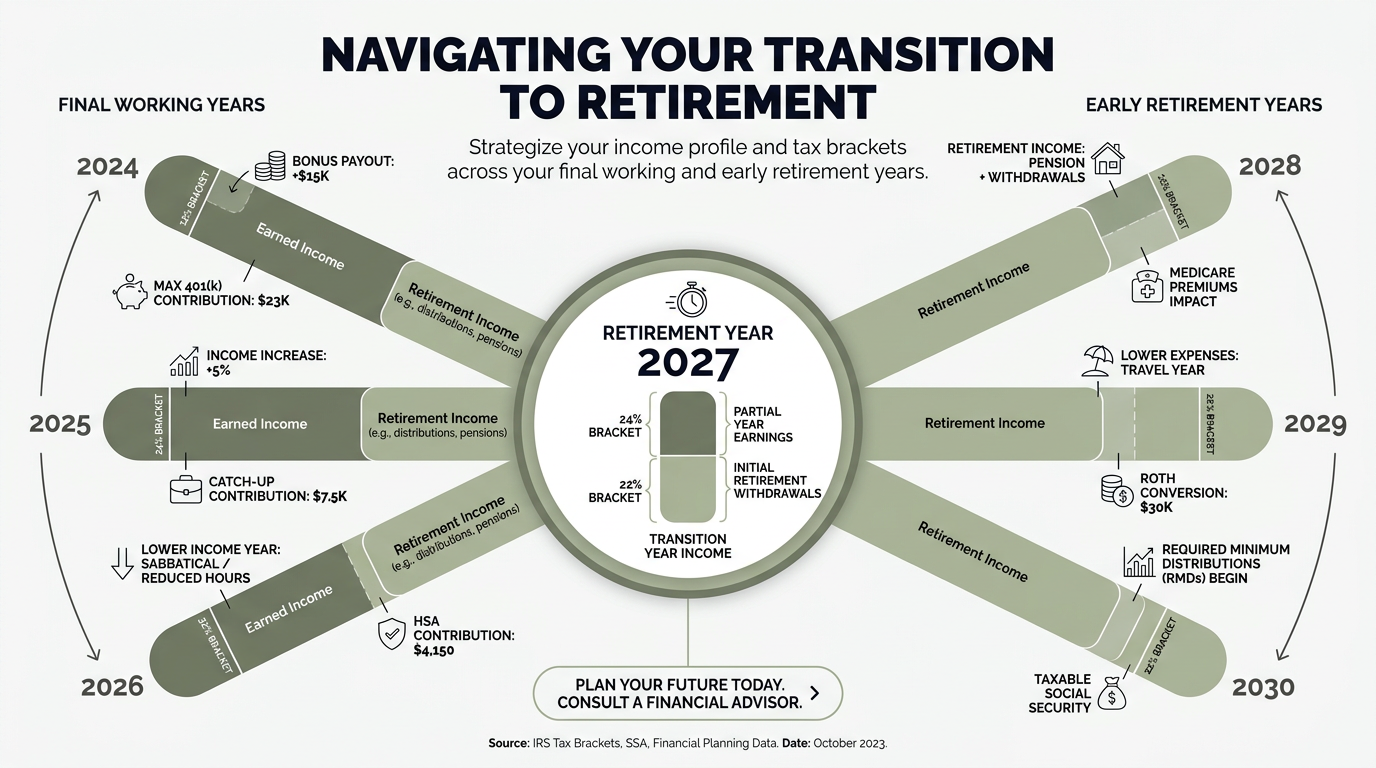
Radial timeline infographic showing final working years into early retirement with labeled spokes for bonus timing, retirement contributions, and lower-income years, highlighting how tax brackets can shift across adjacent years. Clean, on-brand colors and Raleway typography with a short call-to-action and source line at the bottom.
Most people treat Roth conversions, charitable giving, and retirement withdrawals as three separate decisions made in three separate conversations. For high-income earners approaching retirement, that separation is expensive. A Roth conversion that fills a low-income year bracket reduces the IRA balance subject to future required minimum distributions. A qualified charitable distribution from that same IRA in a high-income year keeps a distribution from counting as taxable income at all, which protects the bracket available for conversions the following year. Each decision shapes the one that comes after it.
The best Roth conversion windows tend to open after earned income drops and before required minimum distributions begin at age 73. Converting in that gap moves pre-tax dollars into tax-free growth at a lower marginal rate. One important constraint: under IRS rules, conversions are fully taxable in the year they occur and cannot be undone, so the right amount to convert each year depends on careful calibration against your full income picture.
Year-end donations are easy to overlook until December. Planned giving does more. When charitable goals are mapped alongside income and appreciated assets, the tax benefit compounds. Donors aged 70½ or older can make a qualified charitable distribution directly from an IRA, satisfying part of an RMD without the distribution counting as taxable income. That single move reduces adjusted gross income, which can also affect Medicare premiums and other income-based thresholds.
A tax-efficient withdrawal order typically means drawing from taxable accounts first, then tax-deferred accounts, then Roth accounts last. But that order shifts depending on your tax bracket in any given year, Social Security timing, and whether a Roth conversion window is still open. The goal isn't to minimize taxes in one year. It's to keep total taxes across retirement as low as possible by deciding when to recognize income, which accounts to preserve, and how each withdrawal interacts with the next.
The closer you get to retirement, the more specific the tax questions become. These answers address what comes up most often for high-income earners thinking through income timing, Roth decisions, and how giving fits into the bigger picture.
The key is recognizing when a lower-income year is coming and planning around it. If you know retirement is two years away, deferring a bonus or accelerating deductions into a high-income year can shift your tax bill meaningfully. This works best when it is coordinated with your expected retirement date, not decided in December.
Roth conversions tend to make the most sense in the gap between your last paycheck and when required minimum distributions begin. In those years, taxable income often drops, which creates room to convert pre-tax IRA dollars at a lower rate. Converting too much too fast, though, can push you into a higher bracket or trigger Medicare surcharges.
Both strategies work by controlling when income is recognized, and keeping it in a lower bracket across more retirement years rather than spiking in one. Donating appreciated stock avoids capital gains while generating a deduction. A qualified charitable distribution from an IRA keeps the distribution off your tax return entirely, which can also lower adjusted gross income enough to affect Medicare premiums. Layer that with a withdrawal sequence that draws from taxable accounts first, tax-deferred accounts next, and Roth accounts last, and you are deciding how much income appears each year, rather than discovering it after the fact.
The tax choices that matter most are rarely the ones made in a rush at year-end. They are the ones made early enough to shape how income lands, which accounts carry the heaviest tax burden, and what options remain once RMDs begin at age 73 and Social Security locks in. Once those timelines are set, some of the most effective moves are simply no longer available.
Coordinating income timing, Roth conversions, charitable giving, and withdrawal sequencing is not a one-year project. It is an ongoing strategy that works because each decision supports the next one. Fortitude Wealth Planners connects retirement, investments, insurance, tax planning, estate considerations, and wealth transfer into one plan so nothing is managed in isolation. Through Vicki Beam's membership in Ed Slott's Elite IRA Advisor Group, our retirement and distribution planning directly addresses the IRA, Roth, and RMD decisions that tend to carry the steepest long-term tax consequences. If you are within a few years of retirement and want to see where your tax picture stands, explore our tax planning strategies to start building a plan before the window narrows.