


Umbrella Insurance Explained: Do You Need More Liability Protection?
Umbrella Insurance Explained: Do You Need More Liability Protection? A single liability claim can run into the millions. If your home or auto policy c...
When a disability hits at 45, most people expect an insurance problem. What they get is a financial plan problem. Retirement contributions stop. Savings that were meant for college get redirected to the mortgage. The estate plan, still naming a former employer's group policy as the primary vehicle, quietly falls short. According to the Insurance Information Institute, a significant share of American households remain underinsured, but the real cost isn't just the missing benefit. It's what unravels downstream when coverage doesn't hold.
That's why insurance should be treated as a planning decision, not a product decision. Life insurance, disability protection, and liability coverage each protect a different part of your financial life: retirement progress, debt obligations, estate intentions, and family goals. When they're coordinated with the rest of your plan, a single crisis doesn't become a cascade. Fortitude Wealth Planners helps individuals and families build that kind of connected plan, where every coverage choice earns its place in the broader picture and gets reviewed as that picture changes.
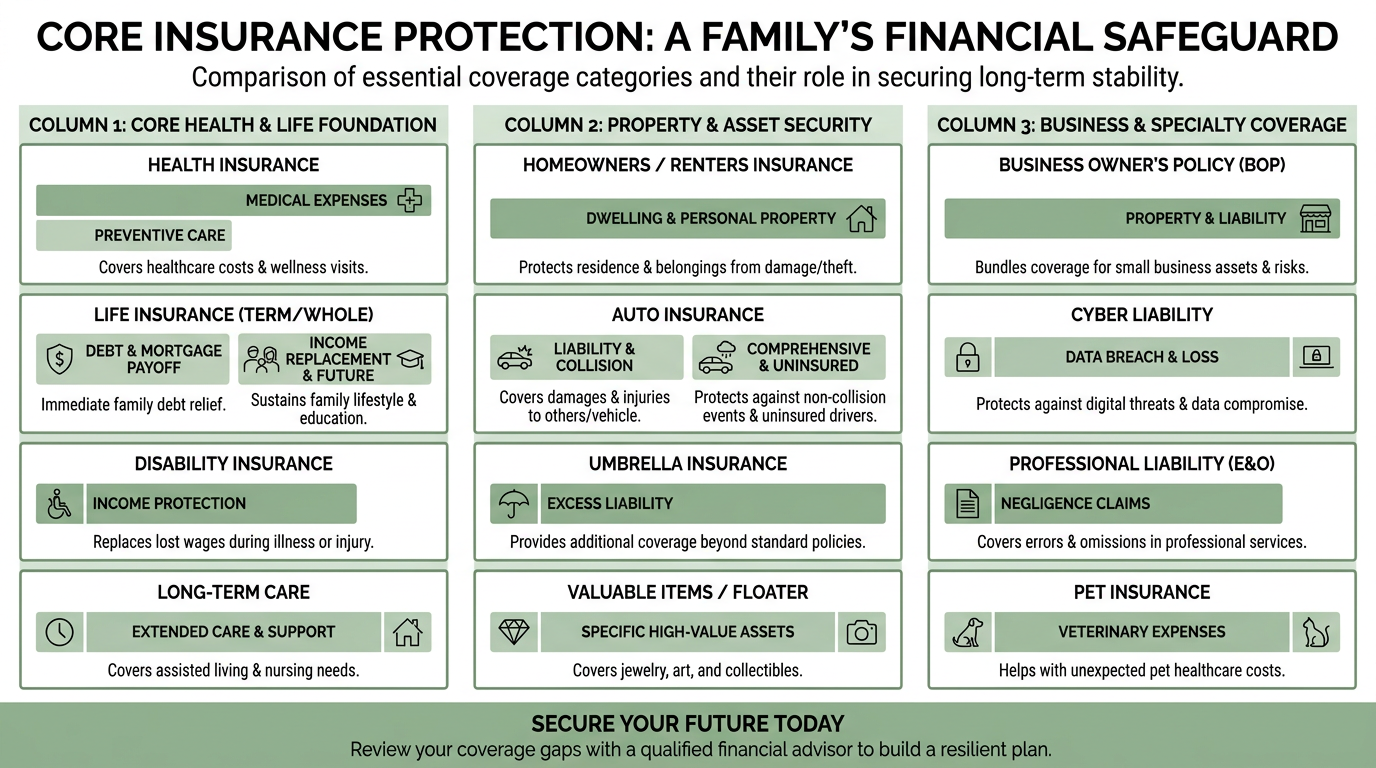
Most people think about insurance one policy at a time, usually right after a life event prompts them to act. But a complete plan looks at coverage categories together, because each one protects a different corner of your financial life, and a gap in any one of them can put pressure on the others. Four categories form the foundation of most families' protection strategy: life, disability, property and casualty, and liability coverage.
|
Insurance Type |
What It Protects |
Where It Fits in a Broader Plan |
When Gaps Commonly Appear |
|---|---|---|---|
|
Life Insurance |
Replaces income and covers debts, childcare, and future goals if a breadwinner dies |
Supports mortgage payoff, estate transfer, and a surviving spouse's retirement savings |
When coverage is employer-only and doesn't account for family debt load or long-term income needs |
|
Disability Insurance |
Replaces a portion of income if illness or injury prevents you from working |
Keeps retirement contributions, debt payments, and household cash flow intact during recovery |
When employer short-term coverage ends and no individual policy bridges the gap |
|
Home/Auto Coverage |
Protects physical assets and covers liability from accidents tied to property or vehicles |
Prevents a single event from forcing a household to liquidate savings or take on new debt |
When policy limits haven't kept pace with rising home values or added assets |
|
Umbrella Liability |
Extends liability coverage beyond home and auto policy limits |
Shields accumulated wealth, investments, and future earnings from large legal judgments |
When net worth has grown but underlying liability limits haven't been adjusted to match |
No single policy covers everything, and that's exactly the point. Each category connects to a different part of your financial plan, which is why reviewing them together, rather than in isolation, gives you a clearer picture of where your family is genuinely protected and where you may be exposed.
The most common mistake families make with life insurance is picking a number that sounds big enough rather than one that's actually built around their life. A generic rule of thumb, like "ten times your salary," might get you in the ballpark, but it won't account for your mortgage balance, what college will cost in fifteen years, or what your spouse would need to stay on track for retirement if you were no longer in the picture. The CFP Board frames it more precisely: start with the annual income shortfall your family would face, then convert that into a lump sum using a conservative expected return of around three to five percent. That gives you a coverage target grounded in real cash flow needs rather than a guess.
It's also worth knowing that Social Security survivor benefits exist, but they typically replace only a portion of lost earnings, and they come with eligibility rules, family maximums, and earnings limits that can reduce what your family actually receives. Life insurance fills the gaps that survivor benefits leave open, particularly for things like a mortgage payoff, education funding, or long-term support for a spouse who needs time to rebuild financial footing.
A few factors that should shape your coverage amount:
When insurance decisions connect to the rest of your financial plan, the coverage amount stops being a standalone guess and becomes a number you can actually defend. That's the difference between a policy that checks a box and one that genuinely holds your plan together.
Your paycheck doesn't just cover the mortgage. It funds retirement contributions, college savings, and everything else your financial plan is built around. When it stops, those goals don't pause, they compete for whatever savings you have left. That's what makes disability coverage a planning decision, not just a benefits question. The right policy keeps the rest of your financial life intact while you recover. The wrong one, or no individual policy at all, forces tradeoffs between retirement and rent.
Most people think of disability as a worst-case scenario. The data says it's a real and fairly common one. Research from the Employee Benefit Research Institute shows that people who experience disability retire earlier than planned, carry more medical and credit-card debt, and end up with significantly lower assets than those who don't. A health event doesn't just pause income. It pulls at every other financial goal at once.
Most employer plans offer short-term disability benefits, but the coverage window is limited, often 90 to 180 days, and long-term group policies typically replace only 60 percent of base salary. That may not be enough to keep retirement contributions going, cover a mortgage, and manage household expenses through a longer recovery. NBER research found that disability benefits meaningfully reduce the likelihood of bankruptcy, foreclosure, and eviction, which signals just how quickly finances unravel when income disappears and coverage runs short.
Three policy details shape how well disability coverage actually performs: the benefit amount, the waiting period, and the definition of disability. A longer waiting period, sometimes 90 days or more, means you need enough liquid savings to bridge that gap before benefits begin. A narrower definition of disability, one that requires you to be unable to work any job rather than your specific occupation, can reduce what you actually collect. An SSA study found that disability near retirement age substantially reduces earnings and increases financial vulnerability, particularly for households without strong savings buffers. Reviewing these details within your broader retirement planning strategy, rather than treating them as HR enrollment choices, is what turns disability coverage into a plan that holds up when it needs to.
Insurance coverage isn't something you set once and forget. Life moves fast, and coverage that made sense three years ago may leave real gaps today. The questions below address the timing and coordination decisions that matter most as your family and finances evolve.
At a minimum, a once-a-year check is worth building into your routine. The NAIC recommends an annual insurance review to confirm that coverage amounts, deductibles, and policy types still reflect your current life. A lot changes in twelve months, even when nothing dramatic happens.
Each of these events shifts what you need to protect. A new mortgage increases your liability exposure. A child adds years of income dependence to your coverage calculation. A salary jump may mean your existing disability or life coverage no longer reflects what your household actually relies on. The NAIC's life insurance guidance specifically flags these milestones as triggers to reassess coverage amounts, beneficiary designations, and policy features.
Beyond the annual check, certain changes require attention sooner. Healthcare.gov defines qualifying life events as situations that open enrollment windows and signal a meaningful shift in your financial or family situation. Marriage, divorce, the birth or adoption of a child, a job change, and a significant income shift all fall into this category. Any of these can change what coverage you need and what you can afford.
Insurance works best when it's reviewed alongside the rest of your financial plan, not separately from it. A life insurance policy with a growing cash value, for example, can have tax implications worth coordinating with your broader tax planning. Disability coverage gaps can quietly threaten retirement contribution rates if a health event occurs during peak earning years. Reviewing these decisions together creates a more resilient plan than managing each piece on its own.
Beneficiary designations on life insurance policies are part of your estate, whether or not you have a formal estate plan. A policy that names an ex-spouse or skips a newly born child because the paperwork wasn't updated can undercut your intentions entirely. Coordinating insurance reviews with estate planning conversations keeps your coverage aligned with who you actually want to protect and how.
The goal of insurance planning isn't to own the right policies. It's to make sure a health event, an accident, or an unexpected death doesn't force your family to choose between the mortgage and retirement savings, or between an estate plan and an emergency fund. As the IRS confirms, the tax treatment of life insurance and disability proceeds depends on how policies are structured and who pays the premiums, which means the details matter as much as the coverage amount itself.
Coverage that isn't reviewed alongside your retirement timeline, tax picture, and estate intentions is coverage that can surprise you. Beneficiary designations drift out of date. Disability limits stop reflecting what your household actually earns. Liability limits stay fixed while net worth grows. None of those gaps announce themselves. They show up when it's too late to fix them cleanly. Fortitude Wealth Planners helps individuals and families assess where they're genuinely protected and where they're exposed, then build coverage strategies that stay connected to the full financial picture as life changes.