


The Biggest Retirement Planning Mistakes to Avoid in Your 50s and 60s
The Biggest Retirement Planning Mistakes to Avoid in Your 50s and 60s Most retirement mistakes don't announce themselves. They happen quietly, years b...
You can own dozens of funds across multiple accounts and still have a portfolio that does not hold up when retirement actually begins. A mix of assets is not the same as a plan. As the SEC's investor guidance explains, diversification means aligning your asset mix with your time horizon, income needs, and risk tolerance, not simply spreading money across categories and hoping it works. The closer you are to leaving full-time work, the more that distinction matters.
A well-built portfolio goes beyond which assets you own. It connects to which accounts hold them, when you draw from each, and how those withdrawals interact with your tax bracket, Social Security income, and RMD timeline. The same holdings in the wrong accounts, drawn in the wrong order, can produce a very different retirement than the one you planned for. Fortitude Wealth Planners helps individuals and families build that kind of coordinated strategy specifically where investment decisions, tax planning, and distribution sequencing work together instead of each running on its own track.
Choosing the right asset allocation is less about picking a number and more about understanding your retirement timeline and what you can realistically afford to lose along the way. How you answer those questions shapes everything else in the portfolio.
A portfolio built for retirement in two years carries very different stakes than one built for retirement in twenty. If markets drop sharply right before you stop working, there is little time to recover. That timing risk, not just return potential, should anchor how you split between stocks, bonds, and cash from the start.
You might be emotionally comfortable with market swings, but that comfort does not automatically mean your finances can absorb them. Risk capacity is about what your situation can withstand. Once a paycheck stops, a prolonged downturn can force you to sell at the wrong time just to cover living expenses, which is a very different problem than watching a balance temporarily drop.
Chasing a specific return number without a spending plan behind it is guesswork. A clear allocation makes more sense when it connects to how much you will need each year, what you plan to keep in reserve, and when withdrawals will begin. The goal is a portfolio that can fund your life, not just one that looks good on a performance report.
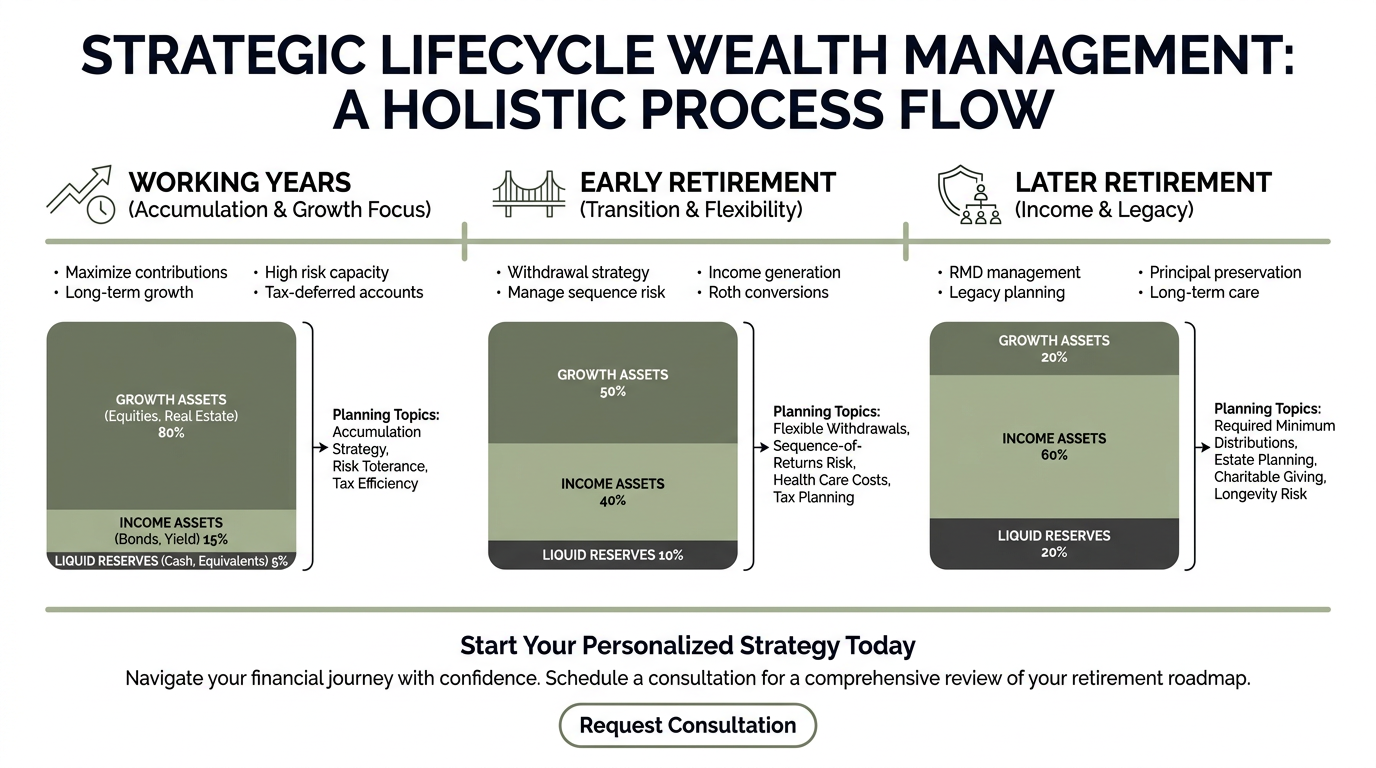
Not all holdings in a portfolio are there for the same reason, and that distinction matters more as retirement gets closer. A well-built portfolio is less about owning a long list of funds and more about making sure each position is doing a specific job. As the SEC's guide to asset allocation explains, stocks, bonds, and cash each behave differently under the same market conditions, and that difference is exactly what makes the combination more stable than any single holding on its own.
Think of it in three broad roles. Stocks carry the growth work over time. Bonds and cash handle near-term income needs and give you something to draw from without being forced to sell equities after a downturn. When those roles are clearly defined, the portfolio becomes easier to manage and easier to trust when withdrawals actually begin. Research on life-cycle investing supports this approach, showing that shifting the balance of a portfolio toward stability and income as retirement nears tends to reduce the risk of a major loss at exactly the wrong time.
Here is how that plays out in practice:
The point is not to own more categories for the sake of variety. It is to build a portfolio where every position connects to your income needs, your timeline, and your plan for how retirement actually gets funded. At Fortitude, investment strategy and retirement planning are reviewed together, so each position in your portfolio connects to when and how you plan to draw income.
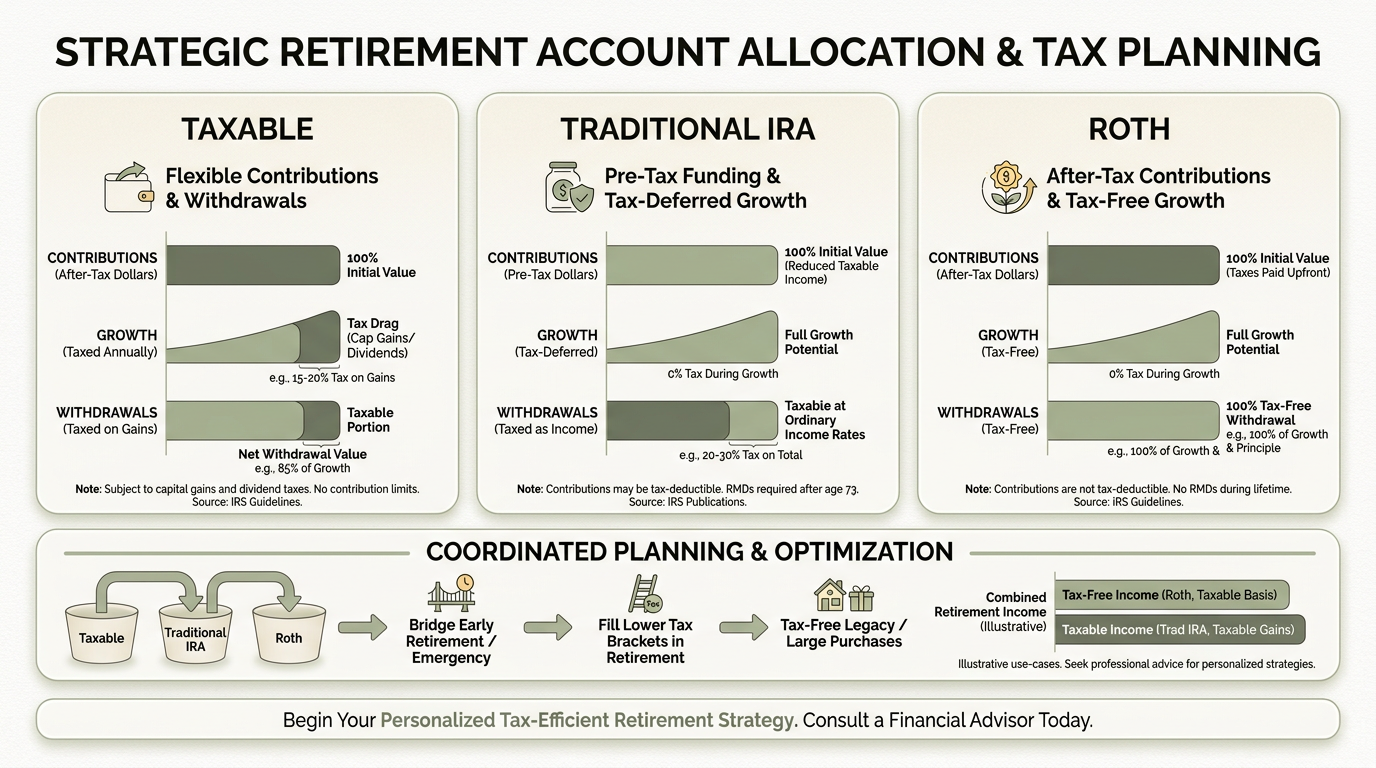
Making a portfolio more tax-efficient before and after retirement starts with one question most investors skip: not just what to own, but where to hold it. The answer affects how much of your portfolio you actually keep after taxes, and it connects directly to IRA rules, Social Security timing, and distribution strategy.
Tax efficiency is part of diversification. Two portfolios with identical holdings can produce very different after-tax results depending on which accounts those holdings sit in. Research from Stanford's SIEPR found that the right asset location strategy can meaningfully increase after-tax wealth, though the optimal placement depends on income level, account types, and the specific investments involved. There is no universal rule here, which is exactly why it requires individual planning rather than a general template.
Taxable, tax-deferred, and Roth accounts each behave differently, and placing investments across them with intention supports both near-term tax efficiency and long-term withdrawal flexibility. Roth accounts carry no required minimum distributions during your lifetime and allow contributions regardless of age, making them useful tools for managing taxable income in retirement. Tax-deferred accounts like traditional IRAs defer taxes now but create taxable income later, so how much you accumulate there directly shapes your future tax picture. Fortitude's tax planning approach treats these account decisions as part of a coordinated, year-round strategy rather than a one-time setup.
A Roth conversion, for example, is not just a tax move. It is also a portfolio decision that affects future withdrawal sequencing, RMD exposure, and estate planning. Per IRS guidance, conversions are irreversible, which means the timing and amount need to be weighed carefully against your current tax bracket, Social Security income, and expected future distributions. When your retirement planning and investment strategy are reviewed together, these connections become visible before you make a move you cannot take back.
Rebalancing is one of those tasks that feels optional until it isn't. As retirement gets closer, the stakes around timing and triggers go up, because a portfolio that drifts too far from its intended mix can expose you to more risk than you planned for, or less growth than you need.
Most financial planners recommend reviewing your portfolio at least once a year and rebalancing when any asset class drifts meaningfully from its target. As Investopedia notes, a common threshold is a 5% shift in any position before triggering a rebalance. Sticking to a set rule takes the guesswork out of the decision.
Not automatically, but intentionally. The direction is right, shifting toward more stable, income-oriented holdings as retirement nears makes sense, but the pace depends on your income needs, spending plan, and other assets. Morningstar's guidance reinforces that rebalancing is primarily a risk-management tool, not a mechanical calendar event.
Several life events warrant a fresh look at your allocation. A job change, the start of Social Security income, a health event, the death of a spouse, or an inheritance can all shift your income picture and risk capacity in ways that markets alone won't reflect. Fortitude's financial planning process is built around exactly these kinds of transitions.
It can, especially in taxable accounts where selling appreciated holdings triggers capital gains. One practical approach is to rebalance first within tax-deferred or Roth accounts, where there is no immediate tax cost. Fortitude's tax planning work integrates this kind of sequencing so rebalancing decisions do not create unnecessary tax bills.
Once RMDs begin, those required withdrawals can actually serve a rebalancing function. Morningstar points out that directing RMDs from overweighted positions is a tax-efficient way to bring a portfolio back into balance. Coordinating RMD distributions with your investment strategy makes that process more deliberate and less reactive.
A well-built portfolio does not exist in isolation. It works best when it connects to your retirement income timeline, IRS distribution rules, Social Security claiming strategy, insurance coverage, and estate documents. When those pieces are coordinated, your portfolio can do what it is supposed to do: fund the retirement you planned for, not a revised version of it.
Fortitude Wealth Planners reviews your investment strategy alongside your tax picture, distribution timeline, and income needs as one coordinated plan, not as separate conversations happening in separate silos. Vicki Beam's membership in Ed Slott's Elite IRA Advisor Group brings particular depth to the decisions where the stakes are highest: account sequencing, Roth conversions, RMD planning, and how each of those moves affects the others before you make one you cannot take back. When you're ready to build a portfolio that aligns with your goals and the retirement you're actually planning for, book a consultation with our team.