


The Biggest Retirement Planning Mistakes to Avoid in Your 50s and 60s
The Biggest Retirement Planning Mistakes to Avoid in Your 50s and 60s Most retirement mistakes don't announce themselves. They happen quietly, years b...
Most retirement income plans fall short not because the money runs out, but because the tax cost of drawing it down was never part of the strategy. The question of which account to pull from, which year to pull from it, and what that choice does to next year's tax bill often goes unasked until the damage is done. A plan built only around how much to withdraw, without accounting for how each withdrawal is taxed, can quietly erode decades of savings.
A more coordinated approach is possible. When decisions about IRAs, taxable accounts, Roth conversions, Social Security timing, and required minimum distributions are connected to each other and to your broader goals, they support your income instead of competing with it. Fortitude Wealth Planners brings these decisions into one coordinated plan, with retirement and IRA expertise grounded in Vicki Beam's membership in Ed Slott's Elite IRA Advisor Group, so every choice you make works with the ones that follow.
Building a tax-efficient retirement income plan does not start with your investment accounts. It starts with your spending. Until you know what the household actually needs each year, any tax strategy is just guessing. From there, it is about matching the right dollars to the right years in a way that keeps more of your money working for you.
Before any account strategy makes sense, you need a clear picture of your annual income needs in retirement. That means fixed expenses, flexible spending, healthcare costs, and a realistic estimate of how those numbers will shift over time. A coordinated retirement plan is built on this foundation because tax strategy only works when it is tied to real cash flow needs, not hypothetical ones.
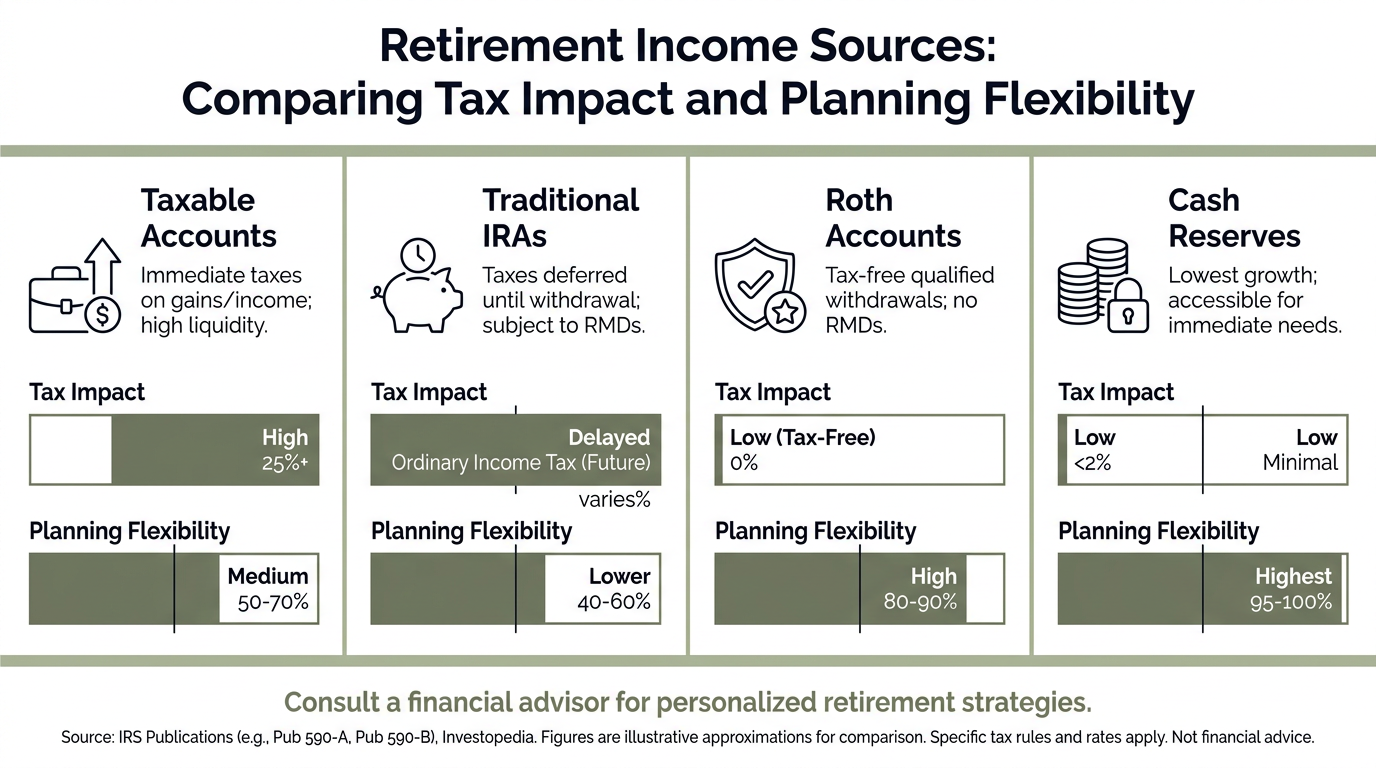
Not all retirement savings are taxed the same way, and that difference matters enormously. Taxable brokerage accounts, traditional IRAs and 401(k)s, Roth accounts, and guaranteed income sources like pensions or Social Security each carry different tax treatment when you draw from them. Sorting your assets into these buckets gives you a clearer view of which dollars will add to your taxable income this year and which ones give you more flexibility. A proactive tax planning approach treats this mapping as the starting point, not an afterthought.
A few retirement choices work together quietly, and punish you quietly when they are made in the wrong order. Claim Social Security before your IRA balance is managed down, and up to 85% of your benefit may become taxable at the same moment your traditional IRA distributions push you into a higher bracket. Convert IRA money to Roth without accounting for that year's other income, and you may fill a bracket that could have been left open for a more valuable conversion two years later. Miss the pre-RMD window entirely, and the mandatory distributions that begin at 73 set your taxable income floor for you, not the other way around. These decisions interact across years, not just within them. That is what makes evaluating them together, rather than one at a time, the difference between a tax plan and a withdrawal schedule.
Most people assume there is a standard order for pulling retirement income: taxable accounts first, then IRAs, then Roth. That sequence is not wrong, but treating it as a rule instead of a starting point carries a specific cost. Spending down your taxable account while leaving a large traditional IRA untouched looks efficient in year one. A decade later, it can produce forced RMDs that push you into a higher bracket you had no hand in choosing. As practitioner modeling consistently shows, a deliberate year-by-year decision about which account mix meets your spending needs, while keeping taxable income in a manageable bracket, does more for long-term after-tax wealth than any single account choice made in isolation.
Each account type behaves differently from a tax standpoint, and the right moment to draw from each one shifts depending on your income picture that year. The breakdown below shows how these accounts compare across four dimensions that matter most when building a year-by-year withdrawal strategy.
|
Account Type |
Tax Treatment of Withdrawal |
When It May Make Sense to Use |
Common Planning Risk |
|---|---|---|---|
|
Taxable Account |
Gains taxed at capital gains rates; cost basis returned tax-free |
Early retirement years when ordinary income is lower; years when you can harvest gains at the 0% rate |
Selling appreciated assets in a high-income year triggers unnecessary capital gains tax |
|
Traditional IRA / 401(k) |
Withdrawals taxed as ordinary income; RMDs required starting at age 73 |
Years when income is temporarily lower; partial withdrawals to fill lower tax brackets |
Delaying withdrawals too long leads to forced, larger RMDs that push income into higher brackets |
|
Roth IRA |
Qualified withdrawals tax-free; no RMDs during owner's lifetime |
Years when taxable income is already high; as a supplement when other sources would push you into a higher bracket |
Using Roth too early in retirement can reduce the tax-free growth benefit and limit future flexibility |
|
Cash / Short-Term Reserves |
No tax event on spending |
Covering near-term expenses without triggering a taxable withdrawal; buffer during market downturns |
Holding too much idle cash reduces long-term growth and may not keep pace with inflation |
A well-coordinated withdrawal strategy is not set once and forgotten. As practitioners at the Journal of Accountancy note, blending account types deliberately each year, rather than defaulting to a fixed order, can make a meaningful difference in after-tax wealth over a long retirement. The accounts you draw from this year directly affect how much flexibility you have in the years ahead.
Most people think about Social Security timing as an income question and Roth conversions as an IRA question. In practice, they are the same question, because each decision affects how much room you have to make the other one. Getting the sequence right is where a coordinated tax strategy separates itself from a simple withdrawal plan.
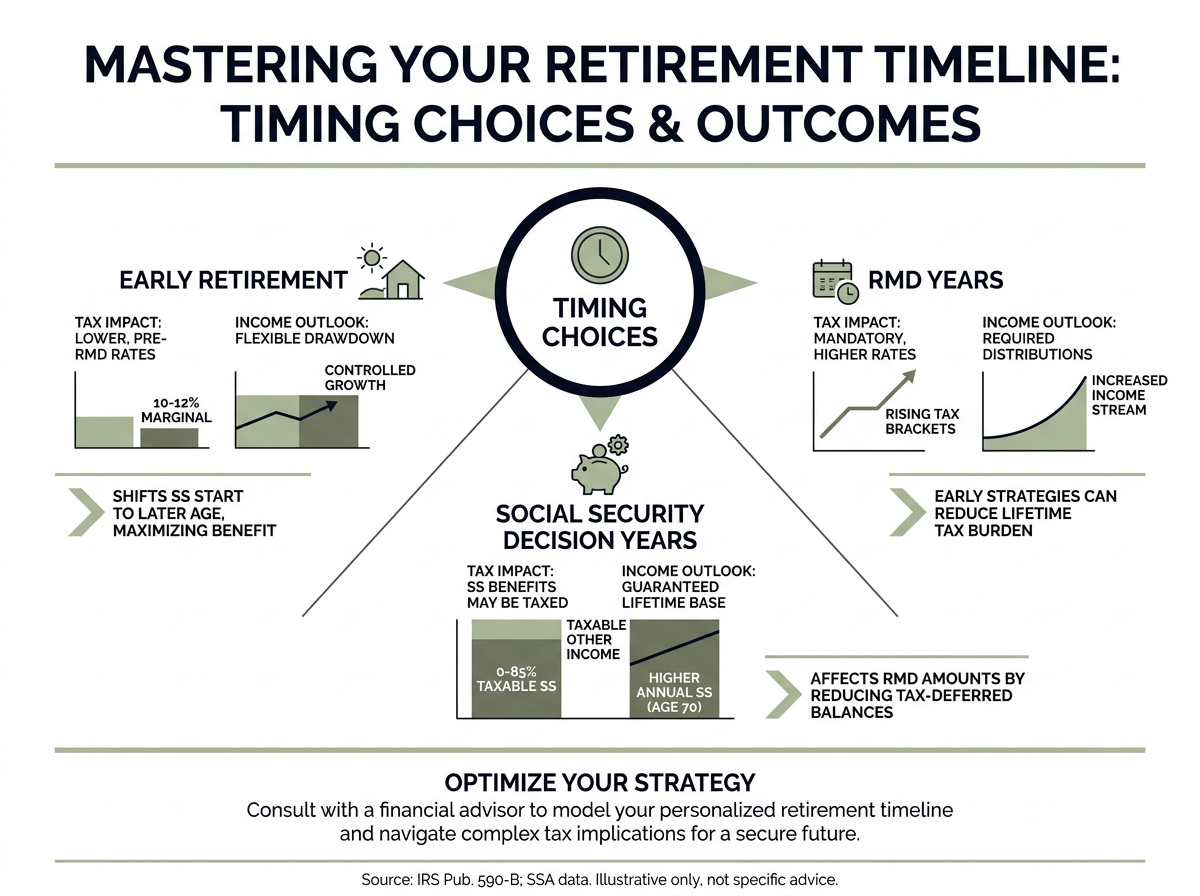
The years between retiring and when required minimum distributions begin are often the most valuable planning window in all of retirement. If you retire at 62 but defer Social Security and have not yet hit RMD age, your taxable income may be lower than it will ever be again. That gap is where Roth conversions tend to make the most sense: you can move money from a traditional IRA into a Roth account, pay tax at today's potentially lower rate, and reduce the balance that will eventually drive mandatory distributions. Once Roth funds are in place, they grow and distribute tax-free, and they are not subject to RMDs during your lifetime. Worth noting: since the SECURE 2.0 Act, RMDs now begin at age 73 for most people, which can extend that conversion window further than older planning rules assumed.
Here is how these decisions interact in practice:
The goal is not to minimize taxes in any single year. It is to manage your lifetime tax bill by treating these decisions as connected, not separate. When Social Security timing, Roth conversions, and RMD planning are coordinated around each other, the plan holds up even as tax law, income, and circumstances change.
The decisions around Social Security, required distributions, and Roth conversions are often where the biggest tax surprises appear in retirement. Understanding how each one works, and how they connect to each other, makes it easier to build a retirement income plan that holds together across the years ahead.
Social Security timing affects your taxes because the Social Security Administration's combined income formula determines how much of your benefit is taxable, and that depends on all your other income in the same year, not just when you claim. Delaying benefits while drawing from other accounts first can keep that taxable share lower in early retirement years, which also preserves more room for IRA withdrawals or Roth conversions.
RMDs begin at age 73 and are calculated from your traditional IRA and 401(k) balances each year. If those balances are large, RMDs can push you into a higher bracket. Planning well before they become mandatory gives you more control over how much taxable income you produce each year.
Roth conversions tend to make the most sense when your taxable income is lower than usual. That window often opens after you stop working but before Social Security and RMDs begin. Converting in those years, while staying within a comfortable tax bracket, can reduce future mandatory distributions and build more tax-free income over time.
A retirement income plan that holds up over time is not built around a single decision. It is built around how all the decisions work together. How you withdraw from taxable accounts, when you claim Social Security, how you manage RMDs, and whether Roth conversions fit your timeline are not separate questions. Each one affects the others, and getting them out of sync can mean paying more in taxes than you ever needed to.
What keeps a retirement plan dependable across 20 or 30 years is not a smarter investment mix. It is the discipline of treating each withdrawal as a tax event and each tax event as part of a longer sequence, one where the choices you make at 63 shape the options you have at 73. That means revisiting withdrawal timing as income shifts, adjusting conversions as tax law changes, and keeping estate and insurance decisions connected to the income strategy rather than managed in a separate conversation.Fortitude Wealth Planners connects all of it in one coordinated plan, with the retirement and IRA expertise, grounded in Vicki Beam's membership in Ed Slott's Elite IRA Advisor Group, to make sure your income strategy and your tax strategy are the same strategy.
Ready to see how your retirement decisions connect? Book a retirement planning consultation and take the first step toward a plan built to last.