


The Biggest Retirement Planning Mistakes to Avoid in Your 50s and 60s
The Biggest Retirement Planning Mistakes to Avoid in Your 50s and 60s Most retirement mistakes don't announce themselves. They happen quietly, years b...
Most parents want to spare their kids from student debt. That instinct is generous, and it can also backfire in ways that are hard to see until the damage is done. According to the National Center for Education Statistics, the total cost of attendance at a four-year public institution, including room and board, can easily exceed $30,000 per year. Commit to covering that without a defined ceiling and the costs can crowd out retirement contributions, drain savings that took years to build, and squeeze the cash flow a household depends on for everything else. The student graduates debt-free. The parents arrive at retirement with less than they planned for, and unlike their child, no comparable options for borrowing the difference.
The better question is not whether to help, but how much to help and through what means. Paying for college and protecting your retirement are not opposites; they just require a plan that treats them as connected decisions. That means setting a real contribution limit, using tax-aware tools like 529 plans where they actually fit, and knowing when some student borrowing makes sense for the family as a whole. Fortitude Wealth Planners works with families to build exactly that kind of coordinated strategy, one where the college funding decision supports the rest of the financial plan rather than competing with it.

How much should parents contribute to college without risking their own retirement savings? For most families, the number gets set by what feels manageable in the moment, the tuition bill that just arrived, what seems fair, what peers are doing, rather than by the retirement projections and cash flow realities that should actually shape it. That gap between good intention and real plan is where college funding goes quietly wrong.
Students have real options for borrowing, including federal loans, income-driven repayment, and forgiveness programs. Parents generally do not have a comparable safety net in retirement. If you drain savings to cover tuition, there is no loan that replaces lost compounding time or delayed contributions. That asymmetry is why retirement savings need to set the ceiling on what you pay, not the other way around.
Many parents say they want to "do whatever it takes" for their child's education. That intention is generous, but without a defined number attached to it, it can quietly crowd out 401(k) contributions, emergency reserves, and other goals that hold the household plan together. A specific contribution target, whether it covers one year, two, or a partial share of all four, gives your child a clear expectation and gives your finances a boundary that actually holds.
The most useful college contribution figure is one that still works if tuition rises, your income changes, or another priority shows up. Build it against your current cash flow and long-term projections, not a best-case scenario. A number that strains the plan in a normal year will break it in a hard one.
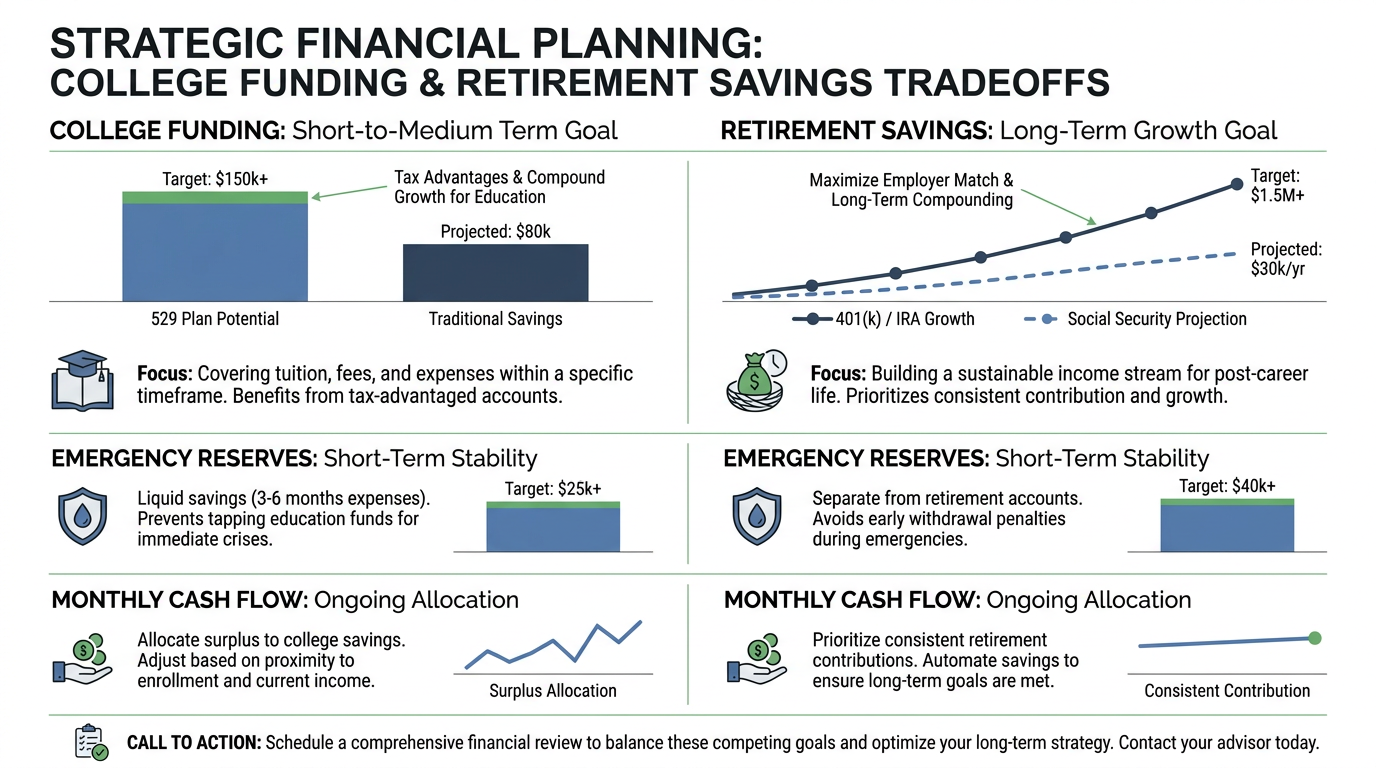
The tax advantages of using a 529 plan to help pay for college are real, but they depend on two things most families underestimate: how early you start and how carefully you match withdrawals to qualified expenses. Earnings grow tax-deferred, and withdrawals for qualified education expenses come out federal-tax-free. Over a decade of consistent contributions, that compounding can noticeably outpace what the same deposits would produce in a taxable account. A 529 opened when a child is young has years to build in ways that one opened in high school simply cannot replicate, and the gap between those two timelines is where the account's tax advantage is actually won or lost.
What the account does not do is make every college funding decision simple. Here is where families get the most out of a 529:
The tax advantages of using a 529 plan are real, but as our college savings guidance makes clear, they work best when the account fits a broader strategy rather than driving it. A family that overfunds a 529 at the expense of retirement contributions, or picks a school based on having the account, may find the tax savings cost more than they saved. The 529 is a good tool. The plan around it is what makes it a smart one.
When families weigh paying college costs outright against letting a child take on some student loans, the instinct is often to frame it as a moral question rather than a financial one. It is worth stepping back from that. The more useful question is which approach keeps the family's full financial picture intact with the least long-term strain, and as our guidance on building a college funding plan makes clear, that answer is rarely the same for every household.
|
Scenario |
Paying Upfront Makes Sense |
Some Student Loans Make Sense |
|---|---|---|
|
Retirement savings |
Parents are on track and paying college costs does not require reducing 401(k) or IRA contributions |
Parents would need to reduce or pause retirement contributions to cover tuition |
|
Cash flow |
College costs fit within monthly budget without borrowing against savings or home equity |
Paying fully upfront creates meaningful strain on monthly cash flow or emergency reserves |
|
529 account balance |
Saved college funds cover most or all of the cost, and withdrawals do not deplete accounts needed for other goals |
529 balance only covers part of the cost; using all of it would leave no flexibility for future education needs or plan changes |
|
Student's buy-in |
Family has agreed on a shared plan and the student understands the full cost |
A defined borrowing share gives the student a stake in the decision and can encourage more thoughtful school selection |
|
Interest rate environment |
Federal student loan rates are high enough that carrying debt costs more than what the family earns keeping money invested |
Loan rates are low enough that keeping savings invested has a reasonable chance of outpacing the cost of borrowing |
|
Overall plan flexibility |
Paying now preserves long-term options without creating new pressure elsewhere |
Some borrowing preserves options, retirement contributions, emergency reserves, other savings goals, that matter more over time |
The comparison that actually helps families is not debt versus no debt. It is whether each funding choice supports the holistic financial plan they have already built. Treating student loans as one reasonable lever, rather than a failure to avoid, often leads to better decisions for both the parents' retirement and the student's long-term relationship with money.
Balancing college costs with retirement savings and monthly cash flow raises practical questions that generic advice rarely answers well. The questions below address the real decisions families face when trying to help with college without losing ground on every other goal.
Start by confirming your retirement contributions are on track, then build college savings from what remains. Overcommitting to college before retirement is funded tends to create a harder problem later. A realistic monthly college target starts with the full budget, not just tuition.
Current income is usually the right place to start because it does not disturb invested assets or trigger tax consequences. From there, 529 withdrawals for qualified expenses come out tax-free, making them the next logical layer. Taxable savings often serve other purposes, so they work better as a backup than a primary source. Our college savings guidance walks through how to sequence these thoughtfully.
Treat college as one line item in the full household plan, not a separate problem to solve alongside everything else. In practice, that means three things: set a defined parent contribution before the school search starts, hold to it even when the tuition bill feels urgent, and revisit the number each year as income, savings, and school costs shift. The families who manage this well are rarely the ones who paid the most. They are the ones who knew their number in advance and held it when the pressure was on.
Revisit the plan before the school year begins, not after a bill arrives. If the school choice shifts to a more expensive option, the question is whether the gap gets covered by additional borrowing, adjusted contributions, or both. As our college funding resource notes, a defined parent contribution limit makes these conversations easier because the boundaries are already set.
Yes, especially when paying more would reduce retirement contributions or drain savings with a longer purpose. FINRA's college savings guidance points out that shorter time horizons and liquidity needs matter when choosing how to fund education. A student loan with a manageable repayment plan is often a better tradeoff than a parent draining accounts that took years to build.
College funding rarely goes wrong because parents chose the wrong account. It goes wrong when the college decision gets made in isolation, separate from retirement contributions, tax strategy, cash flow, and everything else the family is working toward. A plan that connects all of those pieces gives you a defensible answer to how much to pay, when to draw from a 529 plan, and where some student borrowing actually fits without derailing the larger picture.
The families that handle this well are not the ones who spent the most or borrowed the least. They are the ones who made a deliberate choice, grounded in their own numbers, and held to it as things changed. At Fortitude Wealth Planners, holistic financial planning for college and retirement means those decisions move together, not in separate conversations. If you want to support your child's education without compromising the retirement you have spent years building, our financial planning services connect college funding, retirement strategy, and tax planning into one coordinated picture, so the contribution you commit to today is one you can actually keep.