


Why Long-Term Care Planning Matters for Future Healthcare Costs
Why Long-Term Care Planning Matters for Future Healthcare Costs According to the 2025 Milliman Long-Term Care Index, the average 65-year-old faces rou...
A portfolio that felt well-balanced a year ago can drift further than most people expect before retirement arrives. Markets move, and even without touching your accounts, a strong run in stocks can quietly push your allocation from 60% equities to 70% or more. That shift matters more when you are a few years from leaving work than it did when you had decades to recover from a bad stretch.
For people nearing retirement, rebalancing is rarely just an investment question. Selling appreciated positions in the wrong account can create a tax bill you didn't plan for. Shifting allocations in the same year as a Roth conversion can push your combined income into a higher bracket. And trimming equity exposure without coordinating your cash reserves and IRA distribution timeline can leave you drawing from the wrong accounts at the wrong time. A calendar date alone doesn't answer any of that. Fortitude Wealth Planners connects each rebalancing decision to your taxes, IRA strategy, and income timing, so adjusting your portfolio doesn't quietly undo progress somewhere else in your plan.
.png?width=658&height=491&name=couple-reviewing-retirement-paperwork-kitchen-table%20(1).png)
Most people asking whether they should rebalance their investment portfolio on a schedule or only when their asset mix drifts too far are really asking a simpler question: how do I know when something actually needs to change? The honest answer is that the calendar alone is not a reliable guide, especially in the years leading up to retirement when the stakes are higher and the margin for error is smaller.
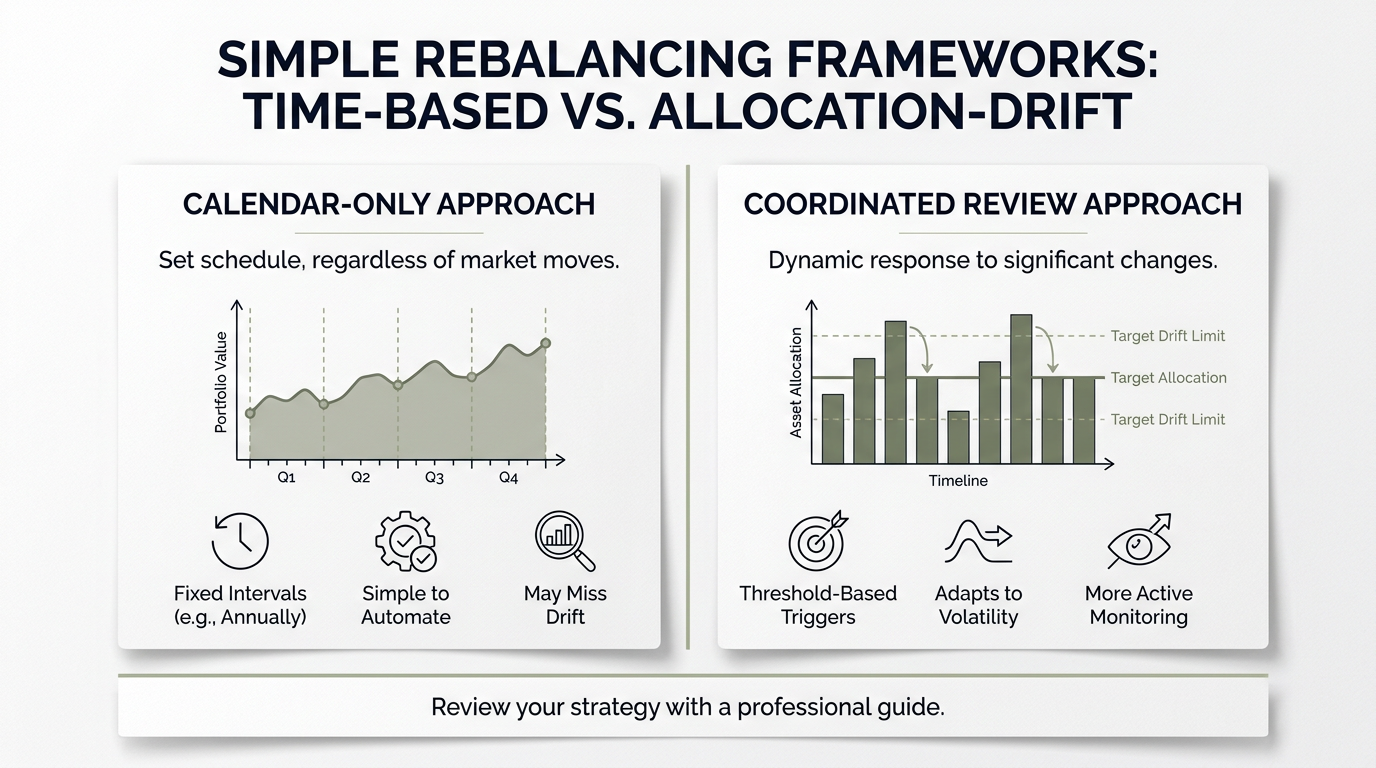
Checking in on your portfolio once a year is reasonable. It builds consistency and keeps you from ignoring your investments entirely. But a fixed annual rebalance, where you adjust automatically because the year turned over, does not account for how much your portfolio has actually moved. A mild year may leave your allocation barely changed. A volatile one can shift it significantly within months. Research from Kitces supports pairing time-based reviews with tolerance bands rather than relying on the calendar alone, because a date-only approach often leads to unnecessary trades or missed drift.
A drift threshold works like a guardrail. You set a target allocation, say 60% stocks and 40% bonds, and you only rebalance when a category moves meaningfully away from that target. Morningstar suggests thresholds in the range of 5% to 10% as a practical rule of thumb. That means if your stock allocation climbs to 68% because of a strong market run, the drift itself becomes the signal, not the month on the calendar. This approach, supported by early research from Arnott and Lovell, tends to produce more disciplined outcomes than lax calendar-only methods.
There is no universal rebalancing schedule that fits every household. Your withdrawal timeline, the mix of taxable and tax-deferred accounts you hold, and your actual risk tolerance all shape what makes sense. Someone five years from retirement carries different exposure risks than someone fifteen years out. Fortitude's investment strategies approach is built for exactly this kind of individualized review, one that weighs your withdrawal timeline and account mix alongside tax planning and IRA strategy, not time horizon alone.
A rebalance that looks clean on a spreadsheet can get expensive once taxes enter the picture. Before making any allocation changes, understand how rebalancing can trigger capital gains taxes, IRA withdrawals, or other tax issues before retirement. Deciding which account you sell from matters as much as what you sell, and the wrong call can cost more than the rebalance saves.
When you sell an appreciated investment in a taxable brokerage account, the IRS treats that sale as a taxable event. Depending on how long you held the position, you may owe capital gains taxes at either ordinary income rates or the preferential long-term rate. For a pre-retiree already in a higher income bracket, that sale can push you into a higher tier than you planned for. The cheapest rebalance on paper is rarely the cheapest one after taxes.
Here is where a more coordinated approach makes a real difference:
A rebalancing decision made without reviewing your full tax picture can quietly undo progress elsewhere in your plan. Connecting the allocation change to your Roth strategy, your IRA withdrawal timeline, and your income projections is what keeps one good decision from creating a problem somewhere else.
When you start drawing retirement income instead of adding contributions, the rebalancing calculus flips. During your working years, a market dip is a buying opportunity and rebalancing means adding to the position that fell. In retirement, that same dip becomes a timing problem: drawing income from depleted stock positions locks in losses, and holding too little in stable assets can force exactly that choice. Research from the CFA Institute confirms that poor early returns in retirement can permanently reduce what a portfolio can sustain, not because the math changes, but because the sequence of withdrawals makes a bad stretch worse. That's why allocation decisions near and in retirement aren't only about risk tolerance. They're also about which assets you can afford to draw from first.
Rebalancing in the years around retirement works best when it is tied to a tax-efficient income plan. Keeping one to two years of spending in stable, liquid assets can reduce the pressure to sell growth positions during a downturn. Research published in the Journal of Financial Planning found that a cash-reserve approach meaningfully improved 30-year plan survival compared to systematic liquidation. When your investment mix connects to Social Security timing, IRA distributions, and cash reserves, rebalancing becomes a meaningful part of your income plan rather than a separate portfolio exercise.

A scheduled review gives your portfolio a regular check-in, but life does not always wait for the calendar. Knowing what major life changes or market moves should prompt a portfolio rebalance before your next planned review can keep your allocation from drifting into territory that no longer matches your actual situation.
A sharp rally or a steep drop can push your stock-to-bond ratio well outside your target range. That kind of drift is worth addressing. What is not worth acting on is a headline that makes you nervous. If the market moves 15 to 20 percent in either direction and your allocation shifts meaningfully as a result, that is a real signal. Market noise is not.
Some events change more than your account balance. Retiring, going through a divorce, losing a spouse, receiving an inheritance, selling a home, or facing a serious health diagnosis can all change how much risk you can afford to carry and how much cash flow you need in the near term. Any of these situations can make your current allocation outdated almost overnight, regardless of when your next review is scheduled.
Markets move constantly. Your plan should not. The real trigger for a rebalance isn't a percentage drop or a headline, it's a change in what you need your portfolio to do. If your retirement date moved closer, your income needs shifted, or your capacity to absorb risk changed, your current allocation may no longer fit your actual situation, regardless of what the market did last month.
The closer you get to retirement, the more a routine portfolio question can have real tax and income consequences. These answers address the specific situations that come up most often for people in the final stretch before leaving work.
Annual rebalancing can work, but it is not a complete answer on its own. Within five years of retirement, your risk capacity is changing and your withdrawal timeline is getting real. A review that also looks at your tax situation, IRA strategy, and income needs will serve you better than a calendar-only approach.
A rally worth acting on is one that meaningfully shifts your stock-to-bond mix outside your target range. The SEC guidance on rebalancing supports reviewing drift rather than reacting to performance alone. If your allocation has not moved outside its threshold, waiting for your next scheduled review is often the more disciplined choice.
Yes, and account location matters here. Rebalancing inside tax-deferred accounts like an IRA or 401(k) does not trigger a taxable event. In a brokerage account, selling appreciated positions can create capital gains, so directing new contributions or reinvested dividends toward underweight assets first is a cleaner approach. The IRS wash-sale rules, covered in Publication 550, also apply if you sell at a loss and repurchase a substantially identical security within 30 days.
Sometimes, yes. If you are selling assets inside a traditional IRA to rebalance, that is also a natural moment to consider whether converting some of those funds to a Roth makes sense given your current tax bracket. Coordinating both moves in the same year can be more efficient than handling them separately. Fortitude's retirement planning process is built around exactly that kind of connected decision-making.
Rebalancing touches your tax situation, IRA strategy, income timing, and the actual risk level you carry into retirement. As FINRA notes, managing a retirement portfolio well means weighing withdrawal plans, sequence-of-returns risk, and tax consequences together. Treating rebalancing as a standalone item misses most of what actually matters in the years before and after you stop working.
A personalized, proactive review can help you decide whether to rebalance now, shift your target mix first, or find a more tax-aware path across your accounts. At Fortitude Wealth Planners, that means tying your allocation decisions to your IRA distribution strategy, Roth conversion timeline, and income plan so a portfolio change does not quietly push you into a higher tax bracket or force withdrawals from the wrong account at the wrong time. If retirement is a few years away and you want a plan that works after taxes, explore our retirement planning services.