


Estate Planning After a Major Life Change | What to Review and Update
Estate Planning After a Major Life Change | What to Review and Update Most people update their will after a major life change and feel like the job is...
A market decline hands you something the tax code rarely offers: a chance to turn a realized loss into a deduction that offsets gains you owe taxes on elsewhere in your portfolio. That is tax-loss harvesting. The benefit disappears quickly, though, if the sale disrupts your portfolio, triggers a wash-sale violation, or works against other tax moves you have planned for the year.
The mechanics are clear enough. What gets harder is the coordination, especially as retirement approaches and tax decisions start affecting each other. The sections below cover how tax-loss harvesting works in a taxable account, when a loss lowers your bill now versus later, and how it fits with the retirement income decisions that surround it. Fortitude Wealth Planners can help you evaluate whether it belongs in your broader tax strategy.

When you sell an investment for less than you paid for it, you realize a loss. Tax-loss harvesting is the intentional act of doing that to reduce your tax bill. The difference between what you paid (your cost basis) and what you received on the sale is the loss you can use.
Realized losses first go against realized capital gains from other investments sold that year. Short-term losses offset short-term gains, and long-term losses offset long-term gains, though leftover losses can cross categories. If losses still exceed your gains, you can use up to $3,000 per year to reduce ordinary income. Anything beyond that carries forward to future tax years.
IRAs, 401(k)s, and other tax-deferred accounts are not part of this equation. Inside those accounts, you do not pay tax on gains as they happen, so there is no realized gain to offset. Tax-loss harvesting belongs in your taxable brokerage account, where investment activity shows up directly on your annual tax return.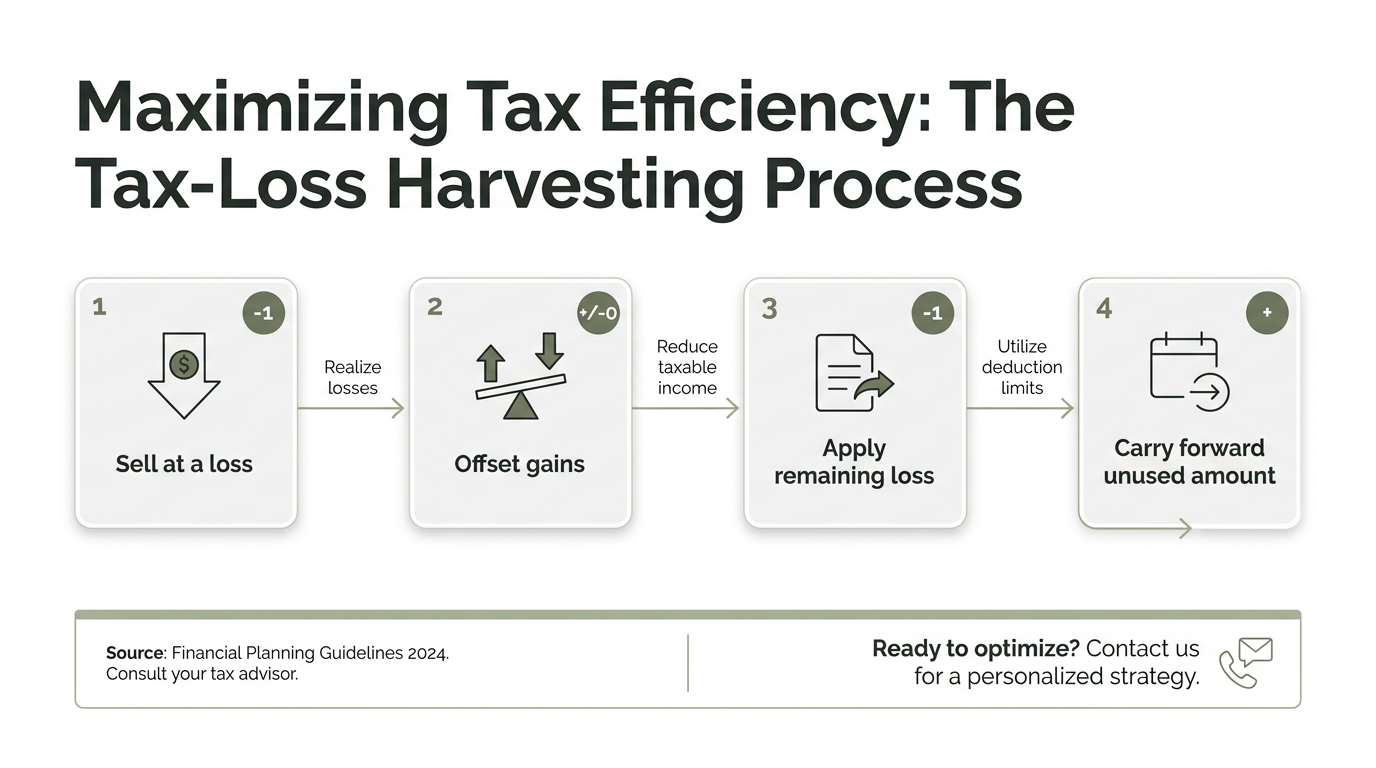
Selling an investment at a loss only saves you money if the IRS actually lets you claim that loss. The wash-sale rule is the most common reason they won't. According to IRS Publication 550, a wash sale occurs when you sell a security at a loss and then buy the same or a "substantially identical" security within 30 days before or after that sale. When that happens, the loss is disallowed for the current year. It doesn't disappear entirely, the disallowed amount gets added to the cost basis of the replacement investment. However, the timing benefit you were counting on is gone.
A few things worth knowing before you harvest a loss:
The wash-sale rule is a genuine technical hurdle, but it's manageable when you plan around it deliberately. The real risk isn't the rule itself, it's treating tax-loss harvesting as a quick year-end move without thinking through the full picture first.
Whether a harvested loss saves you money this April or three tax years from now depends entirely on what else is happening in your taxable accounts and your broader tax picture. The timing of the benefit is not random, it follows a clear sequence.
|
Situation |
What the Loss Offsets |
Current-Year Tax Impact |
What Happens Next |
|---|---|---|---|
|
You have short-term capital gains |
Short-term losses first |
Reduces income taxed at ordinary rates |
Remaining loss moves to next category |
|
You have long-term capital gains |
Long-term losses first |
Reduces income taxed at preferential rates |
Remaining loss applies to ordinary income |
|
No realized gains; some ordinary income |
Up to $3,000 of ordinary income |
Modest reduction to taxable income |
Remaining loss carries forward |
|
Losses exceed gains and the $3,000 limit |
Gains and partial income offset |
Partial benefit this year |
Unused loss carries forward indefinitely |
A loss carryforward is not a dead end, it is real tax value waiting for the right year to be used, whether that is a year with a large Roth conversion, a portfolio rebalance, or an unexpected gain. The key is knowing which scenario you are actually in before you sell, so the decision fits your full retirement income plan rather than standing alone as a year-end reflex.
Near retirement, a tax move that looks straightforward on its own rarely stays that way. A harvested loss sits in the same tax year as a possible Roth conversion, a Social Security timing decision, and RMDs that may be only a few years away, each one affecting how much income you recognize, how much you owe, and how much room you have left to maneuver.
Harvested losses in a taxable account can offset capital gains, but they do not directly offset the ordinary income created by Roth conversions or IRA withdrawals. Still, coordinating these decisions across the same tax year can help you manage your overall taxable income more deliberately. The goal is to keep each moving part working in the same direction.
A tax deduction is not worth much if it leaves you with a portfolio that no longer matches your risk tolerance or retirement income needs. Replacing a sold position with something meaningfully different, just to avoid a wash sale, can create investment drift that is harder to unwind later. The portfolio has to make sense first; the tax benefit is secondary.
Year-end gets most of the attention, but it is not the only window that matters. A meaningful market decline mid-year, a large capital gain from a property sale, or a change in your income plan can each make earlier harvesting more useful than waiting until December. Tax-efficient planning works best when it is ongoing, not a once-a-year scramble.
Tax-loss harvesting can still make sense in a no-gain year, but the immediate benefit is smaller. Without gains to offset, harvested losses can reduce up to $3,000 of ordinary income and carry the rest forward. If you are in a lower income year, perhaps newly retired and not yet drawing Social Security or RMDs, that carryforward may be more valuable in a future year when income rises.
Carryforwards do not expire, so losses harvested today can offset gains from portfolio rebalancing or account drawdowns in future years. If you expect RMDs or Roth conversions to push your income higher in the coming years, building a carryforward now can give you a useful tax buffer when you need it most.
A harvested loss earns its keep only when it improves your overall tax picture, not just this April's return, but the years ahead when retirement income, Roth conversions, and required distributions are competing for the same bracket space. Selling at a loss to capture a deduction makes sense when the move fits your plan. It becomes a distraction when it chases a short-term number while ignoring everything downstream.
Near retirement especially, every tax move touches something else. A coordinated review can help you see whether harvesting a loss actually improves your tax picture, or just defers a problem to a year when your income is higher and your options are narrower. Fortitude Wealth Planners brings together retirement income strategy, IRA distribution planning, and tax planning, grounded in Vicki Beam's membership in Ed Slott's Elite IRA Advisor Group, so you can make these decisions with the full picture in front of you, not just one account or one year at a time.