


Tax-Loss Harvesting Explained | How to Lower Your Investment Tax Bill
Tax-Loss Harvesting Explained | How to Lower Your Investment Tax Bill A market decline hands you something the tax code rarely offers: a chance to tur...
Most retirement mistakes don't announce themselves. They happen quietly, years before you stop working, when one decision changes the tax, income, or risk picture of another, and no one notices until it's too late to course correct. You can do everything right in isolation and still end up with a retirement that's more expensive and less flexible than it needed to be.
The decisions that matter most in your 50s and 60s don't live in separate boxes. When you claim Social Security affects your taxes. When you start drawing from your IRA affects your Medicare premiums. Whether you do Roth conversions now affects how much you'll owe later when required minimum distributions arrive. These decisions are connected, and the biggest retirement planning mistakes usually come from treating them as separate jobs rather than one coordinated plan. Fortitude Wealth Planners helps individuals and families build that connected plan before retirement begins, when there's still time to get it right.

Most people approaching retirement have a date in mind. Very few have a plan for the day after it. That's where the real work starts: the weeks and months when paychecks stop but benefits haven't started, and when decisions about retirement income, insurance, and estate planning can no longer wait for the right moment.
Retirement income planning tends to break down when the retirement date, spending plan, Medicare enrollment, cash reserves, and portfolio withdrawals are each figured out on their own. The retirement date affects Medicare timing. Medicare timing affects whether you need bridge coverage. Bridge coverage costs money that has to come from somewhere. Each choice feeds the next, and deciding them separately is how gaps form.
An otherwise solid retirement plan can be quietly undercut by outdated beneficiary designations, coverage that no longer fits, or legal documents that haven't been touched in years. As Fortitude's own estate planning guidance points out, beneficiary designations on retirement accounts often override what a will says, making them one of the most consequential and most overlooked items to review before leaving work.
A clear retirement timeline does something a checklist cannot: it lets you see how decisions interact. When do paychecks stop? When does Social Security start? Which accounts fund the gap between those two dates? Who has legal authority to act on your behalf if your health changes? Building a tax-efficient retirement income plan means answering those questions in sequence, not in isolation.
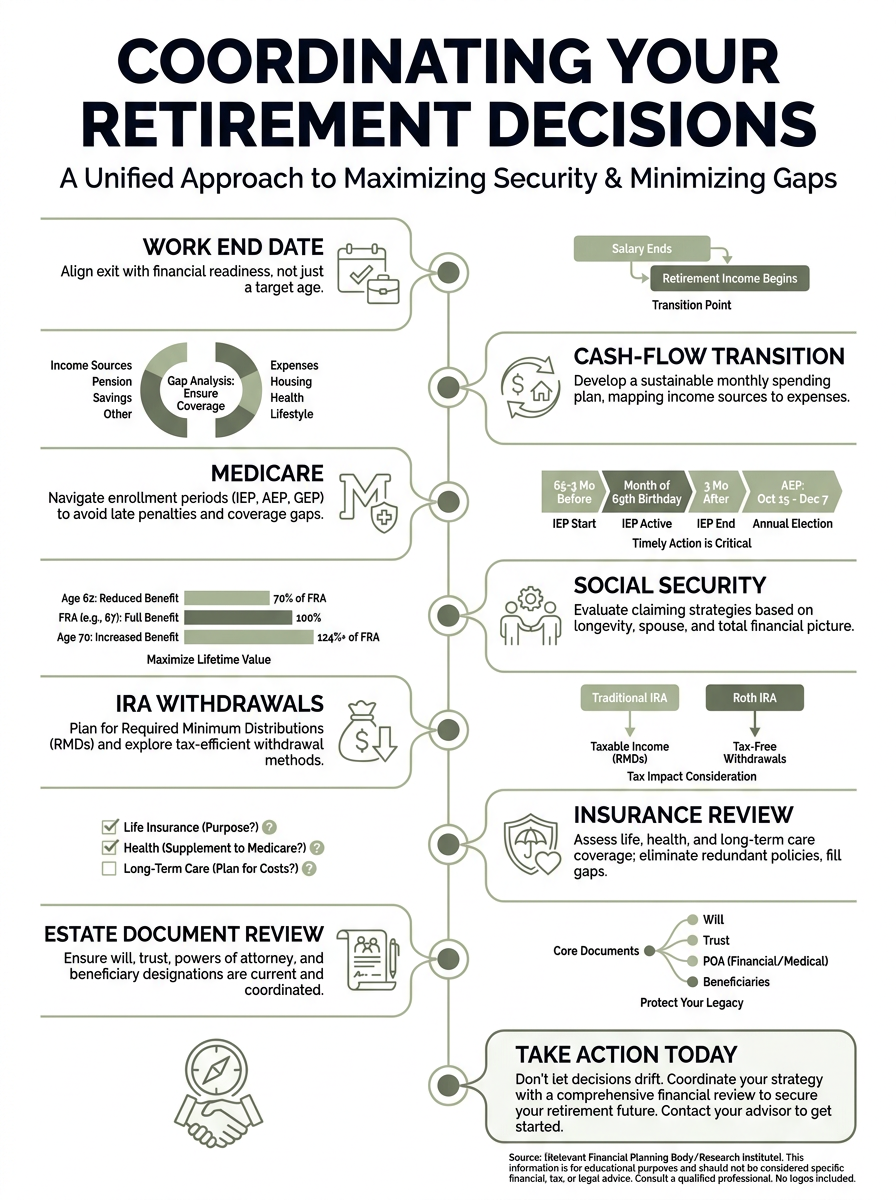
Deciding when to claim Social Security to avoid locking in a lower lifetime benefit is one of the most personal calls in retirement planning, and it rarely has a universal right answer. You can claim as early as 62 or as late as 70, and every year you wait past your full retirement age adds to your monthly benefit. But the math alone does not tell you what to do. The right answer depends on what else is happening in your financial picture.
The timing of Social Security does not live in a silo. At Fortitude, it gets evaluated alongside IRA withdrawal timing, Roth conversion opportunities, and the years just ahead of when RMDs begin, because those decisions all affect each other.
How IRA withdrawals and required minimum distributions affect your retirement taxes in your 50s and 60s depends largely on decisions made years before those distributions are forced. Required minimum distributions begin at age 73, and by the time they arrive, the tax situation is largely set. The years between retiring and that first mandatory distribution are when your options are widest: income is temporarily lower, and you control which accounts you draw from and when. Letting that period close without a plan is one of the more avoidable retirement tax mistakes.
The decisions below do not happen in sequence. Each one changes the conditions for the next, which is exactly why IRA withdrawals, RMDs, Roth conversions, and taxable account spending deserve to be reviewed together rather than one at a time. A tax-efficient retirement income plan treats them as connected, not parallel.
|
Decision |
Best Time to Review |
Main Tax Impact |
What It Affects Next |
|---|---|---|---|
|
IRA withdrawals |
Before retirement and in early retirement years |
Adds to ordinary taxable income in the year taken |
Social Security taxation, Medicare IRMAA thresholds, RMD size at 73 |
|
Required minimum distributions |
Age 70–72, before distributions are mandatory |
Forces taxable income regardless of other income that year |
Tax bracket, Medicare costs, estate value passed to heirs |
|
Roth conversions |
Pre-retirement or early retirement when income is lower |
Taxable in the year converted; conversions cannot be reversed after 2017 |
Reduces future RMDs, grows tax-free, may trigger short-term IRMAA |
|
Taxable account spending |
At retirement, when building the income sequence |
Qualified dividends and long-term gains taxed at lower rates |
Preserves tax-deferred and Roth accounts for later; affects bracket management |
Here is a complication that often catches people off guard: moving money from a traditional IRA to a Roth counts as income in the year you convert, which can push you into a higher Medicare premium tier through IRMAA if the conversion is not sized carefully. That does not mean conversions are the wrong move. It means they need to fit the full tax picture, not just the IRA balance, and that sizing matters as much as timing. Fortitude's tax planning strategies approach Roth conversions with that full picture in view, year by year, rather than as a one-time transaction done on principle.
The retirement planning mistakes in your 50s and 60s that are hardest to recover from tend to follow a pattern: a decision that looked right in isolation created a downstream consequence that wasn't visible until later, sometimes years later. These questions address the specific gaps that most often catch pre-retirees off guard.
They can be, but "worth it" depends on your tax bracket now versus later. The years between retirement and age 73, before required minimum distributions begin, are often a stretch of lower taxable income. Roth conversions sized to your bracket in those years can reduce future RMD pressure. Our tax planning strategies guide walks through how to approach the sizing and sequencing.
Beneficiary designations, life insurance coverage, powers of attorney, and healthcare directives all need review before your income changes, and more often than not, at least one of them is out of date. An outdated beneficiary form can override your will entirely, regardless of what the will says. Our estate planning checklist covers the key documents and the right timing to address each one.
Claiming Social Security too early, underfunding a cash reserve for the income gap between retirement and benefits, and deIaying Roth conversion work until RMDs arrive. Each of these creates downstream tax or income consequences that are difficult to undo. Addressing them now, while you still have earned income and time, makes the biggest difference.
Voluntary withdrawals before age 73 can actually help. Taking modest IRA distributions in lower-income years spreads your tax liability and reduces the balance that will eventually be subject to RMDs. It is a strategy worth reviewing alongside your overall retirement income plan rather than waiting until distributions are forced.
Retirement income, investment sequencing, tax strategy, insurance, and estate documents are not separate tasks. Each one affects the others. Fortitude Wealth Planners builds retirement planning around that connection. Vicki Beam's membership in Ed Slott's Elite IRA Advisor Group means our retirement and tax planning work is grounded in advanced IRA expertise that helps clients recognize how distribution timing, Roth conversions, Social Security, and estate documents interact before those decisions harden. If you are within a few years of leaving work, the most useful thing you can do right now is put the full picture in front of an advisor who can see how each piece affects the others. Once the window closes, some of those decisions don't come back around.