


The Biggest Retirement Planning Mistakes to Avoid in Your 50s and 60s
The Biggest Retirement Planning Mistakes to Avoid in Your 50s and 60s Most retirement mistakes don't announce themselves. They happen quietly, years b...
A strong portfolio can still let you down in retirement. Not because the investments were wrong, but because they were never set up to support real withdrawals, real taxes, and real spending. Research on household retirement decisions shows that the years just before retirement carry some of the highest financial risk of any period in your working life, and most of that risk has nothing to do with market performance alone.
The shift you actually need is not simply becoming more conservative. It is making sure your investments are coordinated with your withdrawal plan, your IRA decisions, Social Security timing, and the income your life will genuinely require. That is the difference between a portfolio that looks good on paper and one that holds up once the paychecks stop. Fortitude Wealth Planners helps you make that shift with a plan that connects every piece.

For most of your working years, the portfolio had one job: grow. Growth and income, though, are not just different destinations, they require opposite disciplines. A growth portfolio is built to stay fully invested through volatility, because time makes up for short-term losses. An income portfolio needs assets you can draw from without damage, on a schedule that doesn't wait for a market recovery. Treating one as the natural next step from the other is exactly where the transition goes wrong. Shifting from growth to retirement income means building a portfolio that can do both: support real withdrawals in real time, without forcing you to sell at the wrong moment.
Accumulation and income are different problems. A portfolio optimized to grow does not automatically know how to pay you. The Department of Labor frames retirement readiness as knowing what you will need, which accounts will fund it, and how your investments support that schedule. That reframe matters. It moves the conversation from "what is my return?" to "can this portfolio fund my life?"
Before you adjust a single allocation, you need a clear picture of your household spending, which income sources cover which expenses, and what the portfolio actually needs to produce. Social Security timing plays a direct role here. The SSA's filing rules affect when benefits begin and how much they replace, which in turn shapes how much your portfolio needs to provide in the early years of retirement. That gap between guaranteed income and real spending is where investment decisions get personal.
Waiting until markets force the issue is one of the more costly ways to restructure a portfolio. Research on withdrawal strategy and sequencing shows that how and when you draw from a portfolio can matter as much as what is inside it. Social Security timing, pension income, and cash reserves should all inform how the portfolio is positioned before your last paycheck arrives, not after.
In the last few years before retirement, a workable allocation divides the portfolio into time-based sleeves: matching near-term withdrawals to lower-volatility assets while keeping longer-horizon money in growth investments. That structure lets you stay invested without being forced to sell at the wrong moment. As Morningstar notes, the five to ten years surrounding retirement represent a heightened "risk zone" where sequence of returns can do real damage, making the structure of the portfolio matter as much as the overall level of risk.
|
Portfolio Sleeve |
Main Purpose |
Typical Withdrawal Horizon |
Planning Role Before and After Retirement |
|---|---|---|---|
|
Cash and equivalents |
Cover near-term living expenses without selling invested assets |
0–2 years |
Funded in the final working years; protects against being forced to sell during an early market decline |
|
Short-term bonds and fixed income |
Provide a stable, accessible reserve that outpaces cash over time |
2–5 years |
Replenishes the cash sleeve as it is spent; reduces reliance on long-term assets during market dips |
|
Diversified intermediate holdings |
Generate income and moderate growth across a medium time horizon |
5–10 years |
Bridges growth and income; helps manage sequence-of-returns risk while allowing for some appreciation |
|
Long-term growth assets |
Sustain portfolio value and purchasing power over a full retirement |
10+ years |
Stays invested through short-term volatility; supports later decades of spending and legacy goals |
Research from the Journal of Financial Planning suggests that starting retirement with a more conservative posture and allowing equity exposure to rise gradually over time can actually improve long-term sustainability, which runs counter to the common instinct to simply reduce stocks and hold that line. The right balance depends on your planned spending, what other income sources like Social Security or a pension will cover, and how much short-term market movement you can absorb without changing your withdrawal behavior. A framework for building this kind of diversified, goal-aligned portfolio starts with those specifics, not a generic age-based formula.
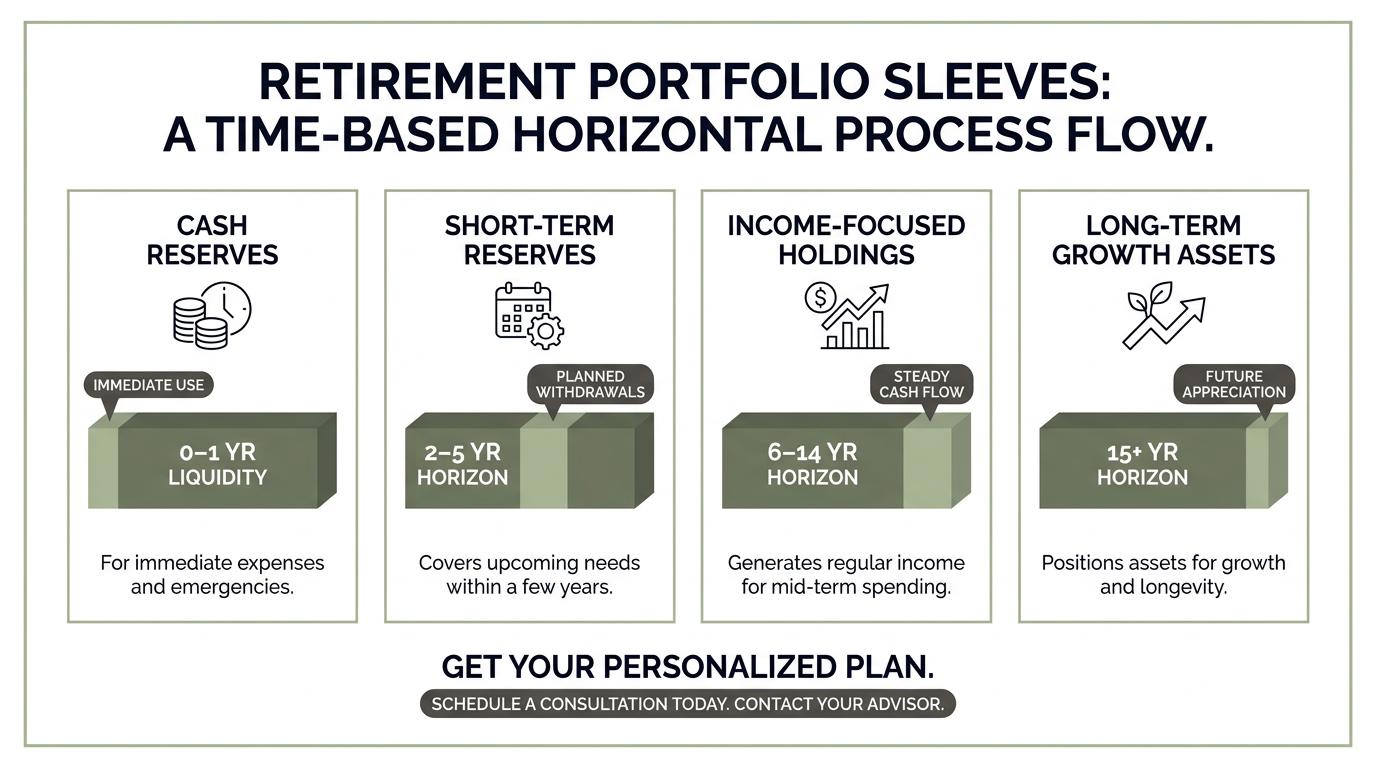
One of the biggest risks in early retirement is not a bad market. It is a bad market at the wrong time. When withdrawals begin, a sharp drop in portfolio value can force you to sell growth assets while they are down, locking in losses before they have a chance to recover. That is what financial planners call sequence-of-returns risk, and it is why how you manage risk in the years right before retirement matters just as much as how much risk you took during the accumulation years.
The strategy is not to exit growth investments entirely. The goal is to structure your portfolio so that near-term spending needs are not dependent on what the market does in any given year.
The goal here is balanced resilience. A portfolio that can weather a down market without forcing you to sell at the wrong time, while still giving your long-term assets room to grow.
Roth conversions and IRA withdrawal planning shape your investment strategy as directly as any allocation decision. The years right before retirement can be one of the last real windows to shape how your accounts work together, because once required minimum distributions begin, your options narrow. This is also where the depth of guidance matters. Vicki Beam's membership in Ed Slott's Elite IRA Advisor Group means Fortitude clients get IRA distribution guidance that goes beyond general planning, the kind of specialized knowledge that turns this window into a real advantage rather than a missed one. Understanding how Roth and traditional accounts compare makes the timing of that window much clearer.
If you retire before Social Security and RMDs kick in, your income may temporarily drop. That can put you in a lower tax bracket than you will be in later. Converting some traditional IRA money to Roth during that window means paying tax now at a potentially lower rate, before RMDs under the SECURE Act force larger taxable distributions starting at age 73.
A Roth conversion is not reversible after 2018, so timing matters. But the payoff is real: Roth accounts have no required minimum distributions during your lifetime, and qualified withdrawals are tax-free. That gives you more control over taxable income in retirement, which affects Medicare premiums, Social Security taxation, and how long your other accounts last. The Form 8606 rules govern how conversions are reported and taxed each year.
Asset location, which investments live in which account type, can meaningfully affect after-tax income. Bonds and income-generating assets often sit more efficiently in tax-deferred accounts, while growth-oriented holdings may work better in Roth accounts where gains are never taxed. Withdrawal sequencing, which accounts you draw from first, works the same way: the order affects your tax bill every year, not just at the end.

The questions that come up most often in pre-retirement investment strategy are not about picking the right funds. They are about timing, coordination, and what to do first. These answers cut straight to what matters most in the final years before retirement.
A common starting point is one to two years of planned withdrawals in liquid, lower-volatility assets. This gives your long-term investments room to recover during a market downturn without forcing you to sell at the wrong time. Fortitude's rebalancing guidance walks through how this fits into a broader withdrawal plan.
Not necessarily. Reducing equity too aggressively before retirement can create a different problem: running short of money later. Starting retirement with a more conservative allocation and letting equity exposure rise gradually can actually reduce the long-term risk of a plan running short, the opposite of what most people expect.
Ideally, before any of the three decisions gets made. The gap between retirement and age 73, when required minimum distributions begin, is often the best window to convert traditional IRA funds at lower tax rates. Social Security timing directly affects that tax picture, so all three need to be looked at as one connected decision, not separately.
Yes, and the order can affect your tax bill every year. Drawing from taxable accounts first, then tax-deferred, and Roth accounts last is a common sequence, but the right order depends on your income, bracket, and what you want to leave behind. This is where withdrawal sequencing becomes part of the investment strategy itself.
The decisions that matter most in the years before retirement are rarely about picking better investments. They are about coordination, making sure your portfolio, your withdrawal plan, your tax picture, and your actual spending all point in the same direction. A portfolio that grew well can still come up short if the IRA decisions, Social Security timing, and withdrawal sequencing were never connected to it.
If your portfoIio hasn't been reviewed against your retirement timeline, your IRA strategy, and your expected tax picture, that is where to start. Fortitude Wealth Planners brings together withdrawal timing, IRA decisions, tax planning, and actual spending into one coordinated plan, built to hold up after taxes, after market swings, and after the paychecks stop.