


How High-Income Earners Can Legally Lower Taxes With a Smarter Plan
How High-Income Earners Can Legally Lower Taxes With a Smarter Plan At age 73, required minimum distributions arrive on schedule, and for high-income ...
Most families don't lose wealth at death because they skipped a will or forgot to set up a trust. They lose it because their beneficiary forms were never updated, their IRA strategy was planned in isolation, and nobody ever connected the tax decisions to the estate documents. The federal estate tax exemption sits at $15,000,000 for 2026, which puts many families outside direct estate tax exposure. Even so, the assets that pass to heirs can carry a significant income tax burden if distributions, account types, and ownership structures were never coordinated.
The clearest path to minimizing estate taxes and maximizing what you leave behind is not a single tactic, it's coordination. An IRA left to the wrong beneficiary passes a large, fully taxable income bill to your heirs. A Roth conversion made without checking your retirement cash flow can create a gap you'll feel a decade from now. A trust that doesn't align with your account titling can accidentally bypass the very protections it was designed to provide. Each decision reshapes the others. Fortitude Wealth Planners brings retirement income, IRA distribution strategy, tax planning, and estate documents together into one coordinated plan, so the legacy you worked to build is the one your family actually receives.
Most conversations about estate tax planning jump straight to tools: trusts, gifting strategies, Roth conversions. Those matter, but they work best when the foundation is already solid. Before choosing tactics, the more useful question is whether your assets are titled, owned, and designated in a way that actually matches what you intend.
Ownership and titling determine more than people realize. IRS Publication 551 makes clear that how an asset is held, whether gifted, inherited, or placed in trust, drives the tax basis an heir receives and the capital gains exposure that follows. A title that seems like a small administrative detail can carry significant tax consequences.
A retirement account passes by beneficiary designation, not through your will, regardless of what it says. A home may transfer by deed, joint title, or probate. Life insurance follows its own path. The transfer mechanism matters because it determines the tax treatment your heirs receive, not just who gets the asset. An IRA that bypasses a trust because the beneficiary form was never updated can force heirs into a fully taxable, 10-year withdrawal window they cannot control. Planning with Retirement Benefits underscores why beneficiary design on retirement accounts is inseparable from preserving tax deferral for the people who inherit them. The right question for each asset is not just "who gets this," but "how does this transfer affect what they actually keep after taxes?"
A review of taxable accounts, retirement accounts, insurance, real estate, and wills and estate documents tends to surface the same recurring issues: an outdated beneficiary form, an account title that contradicts the trust, or an IRA that bypasses the estate plan entirely. IRS Publication 559 outlines how ownership structure and beneficiary designations determine which assets enter probate and which do not, and what the tax consequences are in each case. These mismatches are more common, and more costly, than most families expect. Resolving them is the work that makes every other estate planning decision more effective.
.png?width=1376&height=768&name=asset-map-wealth-transfer-infographic%20(1).png)
Infographic showing a central “Wealth transfer” hub with labeled nodes for retirement accounts, taxable accounts, real estate, insurance, trusts, and beneficiaries connected by arrows and short annotations that explain interactions and tax/estate planning roles.
Beneficiary designations and trusts are two of the most powerful tools in estate planning, but they only work as intended when they are built to work together. How beneficiary designations and trusts protect your legacy depends less on having both in place and more on whether they are pointing in the same direction.
Most people do not realize that beneficiary designations on an IRA, annuity, or life insurance policy control where that asset goes regardless of what your will says. An outdated form naming an ex-spouse or a deceased parent can send assets somewhere your estate plan never intended. Reviewing those forms regularly is not optional; it is foundational.
A trust can offer control, privacy, and structure, but naming a trust as beneficiary without reviewing account titling alongside the trust language can create gaps or unintended tax consequences. The trust document and the accounts that feed it need to be reviewed as a pair, not separately. At Fortitude, our Trusts & Wealth Transfers work always includes that coordinated review.
The goal is not to put every asset into a trust. As the American Bar Association notes, different assets carry different tax and administrative implications depending on how they pass. Some assets are better suited to pass outright; others belong in a trust for control or creditor protection reasons. The deliberate choice between those paths, made with your full financial picture in view, is where estate planning and tax planning genuinely meet.
Most families think about IRA distributions, Roth conversions, and gifting as three separate decisions. They are not. How you handle each one shapes what your heirs receive and how much of it goes to taxes. Planning them together is how IRA distributions should be structured to keep more wealth in the family.
Your IRA is tax-deferred, which means every dollar your heirs inherit from it is fully taxable income when withdrawn. Under the 10-year rule introduced by the SECURE Act, most non-spouse beneficiaries must empty inherited IRAs within a decade. That compression can push heirs into higher tax brackets. Drawing from taxable accounts first and letting retirement accounts grow is not always the right answer; the better question is which sequence produces the lowest total tax bill across your lifetime and your heirs'.
Required minimum distributions begin at age 73, and once they start, you have less flexibility to manage your taxable income. Converting portions of a traditional IRA to a Roth before RMDs kick in lets you pay tax now at a rate you can plan for, rather than leaving heirs to pay it during a compressed 10-year withdrawal window. Roth assets also pass income-tax-free, which makes them one of the most efficient assets to leave behind. The conversion does not reduce your gross estate directly, but it eliminates the income tax that would have eroded the inheritance.
The annual gift exclusion is $19,000 per recipient in 2025 and 2026, and gifts within that limit do not require a gift tax return. Over time, systematic gifting can meaningfully reduce a taxable estate. The risk is giving away assets you may need later. Before committing to a gifting strategy, run it against your projected retirement income, including Social Security timing and distribution needs, to confirm the generosity does not create a gap you will feel in ten years. Coordinating gifting with your broader retirement and tax plan is what keeps it sustainable.
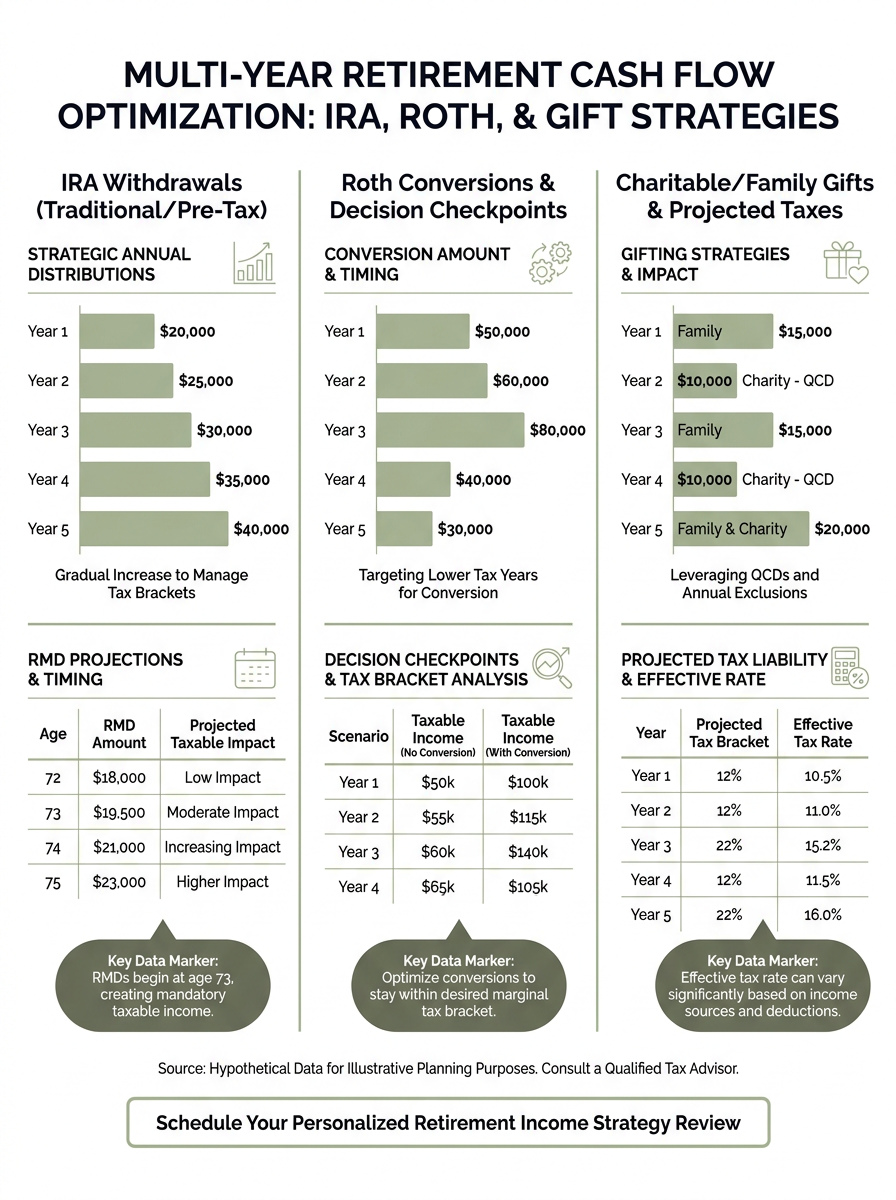
Vertical infographic showing a three-column financial planning worksheet comparing IRA withdrawals, Roth conversions, charitable or family gifts, and projected taxes across multiple years, with bar charts, decision-step icons, and a final call-to-action. Clean white background, muted green accents, and direct numeric labels make comparisons and the step-by-step framework easy to scan.
Estate and legacy decisions tend to surface a handful of questions that do not have clean, one-size answers. The right move usually depends on your retirement timeline, tax situation, and family picture, which is why the answers below are framed around how decisions interact rather than in isolation.
A Roth conversion makes sense for legacy planning precisely because its primary benefit is income tax relief for your heirs. It does not shrink your gross estate directly. What it does do is eliminate the income tax your heirs would owe on an inherited IRA, taxes that arrive compressed into a 10-year withdrawal window under the SECURE Act. Converting before RMDs begin at age 73 lets you pay at a rate you can plan for now, rather than leaving your family to absorb it on a schedule they cannot control.
Systematic gifting within the annual exclusion can reduce your estate over time, but the practical guardrail is cash flow testing. Gift only after confirming your projected retirement income, including Social Security and distributions, can carry the weight of your lifestyle without what you gave away. Generosity that creates a shortfall ten years from now is not a strategy; it is a risk. That coordinated review keeps the giving sustainable.
They need to be reviewed together. A beneficiary form controls where an IRA goes regardless of what a trust or will says. If the trust language and the account titling are not aligned, you can end up with unintended tax consequences or assets passing outside your stated wishes. Life changes, tax law changes, and retirement timing all affect how these pieces interact. Fortitude's Trusts & Wealth Transfers and Wills & Estate Planning work treats those reviews as connected, not compartmentalized.
Yes, and timing matters. The elevated exemption under the Tax Cuts and Jobs Act is scheduled to revert after 2025. The IRS has confirmed that large gifts made during the elevated exemption window will not be clawed back after the reduction takes effect. That makes 2025 and 2026 a meaningful window for individuals with larger estates to act on gifting or trust strategies before the threshold drops. Whether that applies to your situation depends on your estate size and overall plan, which is exactly the kind of question worth reviewing now.
Most estate planning conversations end with a document review. A durable legacy plan starts much earlier, with the IRA distribution sequence you set today, the Roth conversion you consider before RMDs begin at 73, and the beneficiary forms that have not been opened since the account was first funded. Those decisions, made during your lifetime, determine how much of what you built your family actually keeps. An exemption threshold is just a number; what protects a legacy is whether your accounts, titles, and estate documents have been built to work together.
That's where Vicki Beam's membership in Ed Slott's Elite IRA Advisor Group makes a direct difference. Retirement and tax decisions like IRA distribution strategy, Roth conversions, and beneficiary design sit at the center of estate planning, and they require expertise that goes well beyond document preparation. Fortitude connects those decisions to your broader financial plan so nothing is handled in isolation.
If you'd like to review how your assets are currently structured and whether they're positioned to transfer the way you intend, Fortitude Wealth Planners can walk you through a Trusts & Wealth Transfers review that ties your estate plan to the rest of your financial life.