


Can You Afford to Retire Early | 7 Financial Questions to Ask
Can You Afford to Retire Early | 7 Financial Questions to Answer Retiring at 58 or 62 feels within reach when you look at your account balance. The nu...
Most people buy life insurance because someone depends on their paycheck. When that paycheck stops, it is easy to assume the policy can go too. But retirement does not eliminate financial risk for the people you love. It changes the shape of it. A surviving spouse may still face an income gap, a tax bill on inherited retirement accounts, or a mortgage that does not disappear just because you stopped working. The question worth asking is not whether you still earn a salary. It is whether the coverage still solves a real problem inside your plan.
That answer looks different for every household, and it rarely lives in the insurance policy alone. It connects to how retirement income is structured, how IRA withdrawals will be taxed, what the beneficiary designations actually say, and what you want to leave behind. Fortitude Wealth Planners reviews coverage as part of that full picture so you are not paying for protection you no longer need, or walking away from coverage that still matters.

Should you keep life insurance in retirement if your spouse still depends on your income? Sit with that question before making any coverage changes, because the answer is less obvious than most people expect. Retirement removes the paycheck, but it does not automatically remove the financial dependency that made the policy worth having in the first place.
Social Security survivor benefits can help a surviving spouse, but the amount depends on claiming age, earnings history, and timing. If your spouse claimed early, that benefit may be reduced. Life insurance can cover what survivor benefits leave short.
The question is not whether you have stopped working. It is whether your spouse could hold the retirement plan together without your pension, portfolio income, or Social Security strategy. Rushed withdrawals, asset sales at the wrong time, or a sharp drop in lifestyle spending are the real risks worth measuring.
Households where one spouse earned significantly more, or where there is a meaningful age gap, carry more income risk at the first death. A retirement coverage review can show whether the policy is still carrying real weight or simply adding cost to the plan.
Life insurance can still help cover a mortgage, debt, or other obligations after you retire, but only when those obligations are real, measurable, and would genuinely put a dent in your family's financial footing. The useful exercise here is separating what you still owe from what you want to leave behind, because those are two very different conversations.
A good starting point is sorting your financial picture into two columns: things that will eventually go away on their own, and things that won't. A mortgage with ten years left falls in the first column. A desire to leave equal inheritances to children from a blended family, or to cover estate costs without forcing a rushed asset sale, belongs in the second. How much life insurance you actually need depends on honestly measuring both sides of that ledger. Our life insurance needs guide walks through that calculation.
Here is what that review typically looks like in practice:
The clearest sign a policy has outlived its purpose is when you cannot name what specific problem it is solving. That is the moment a coordinated review earns its keep.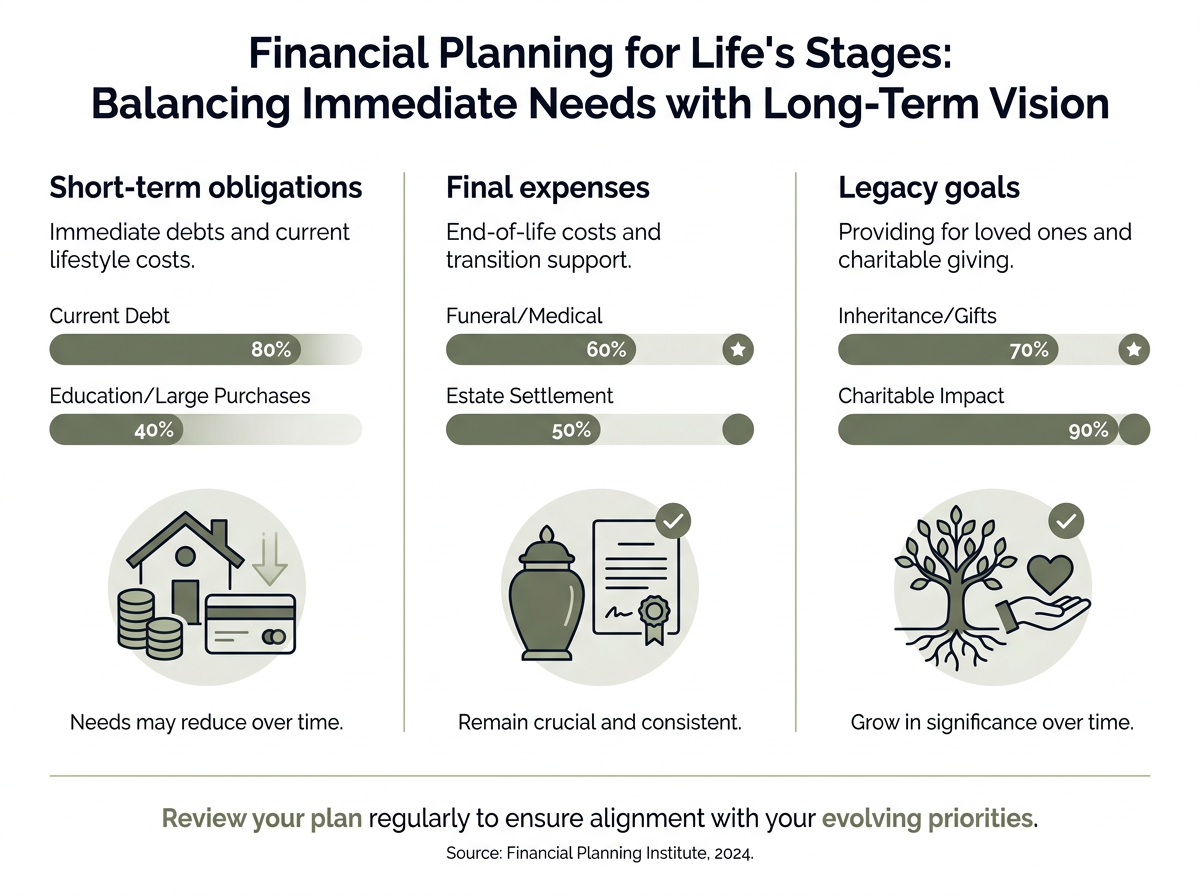
Term life insurance has a timing problem that catches many people off guard. Premiums tend to climb steeply in the final years of a policy, and coverage often expires right around the time retirement begins. If you wait until the policy lapses to ask whether you still need coverage, the window to convert, replace, or extend it may already be closed. Acting a few years before retirement gives you time to weigh all the paths without being forced into a corner.
Converting a term policy to a permanent one can make sense when coverage is still needed but your health has changed enough to make new underwriting difficult. If the original reason for the policy, such as replacing a paycheck or covering a mortgage, has already been resolved, conversion is usually not worth the higher cost. The better question is whether this decision fits with your retirement income plan, tax picture, and estate documents, so that changing one piece does not quietly create a gap somewhere else.
Life insurance decisions rarely come with a simple yes or no, and the closer you get to retirement, the more nuanced the questions become. Each answer points back to the same idea: the policy either solves a problem in your plan, or it doesn't.
Sometimes, yes. Permanent coverage can make sense when it fills a specific gap, such as covering final expenses without drawing down savings, or equalizing an inheritance when assets are not easily divided. For larger estates, policy ownership and beneficiary structure may also affect estate tax exposure, so those details deserve a careful look before you decide.
It depends on what else the policy was doing. Once the debts are gone and the kids are on their own, the original reason for coverage has likely passed. But before canceling, check whether the policy has accumulated cash value, whether a surviving spouse still has income needs, and whether your beneficiary designations still reflect your current wishes.
At minimum, revisit coverage whenever something meaningful changes, such as a shift in retirement income, a Roth conversion strategy, a change in beneficiaries, or an update to estate documents. Even without a major event, an annual check-in is worth the time. Our insurance planning approach treats these reviews as part of the broader retirement picture, not a separate task.
If your health has declined, new underwriting can be difficult or expensive. Reviewing your options before a policy lapses gives you more paths to work with. A conversion option on an existing term policy may preserve coverage without new medical approval, though whether that makes sense depends on your overall retirement plan, not just the policy terms alone.

Life insurance after retirement is not a yes-or-no decision. It is a planning question, and the answer depends entirely on whether your current coverage still serves a real purpose inside your broader retirement picture. If it protects a spouse who depends on your income, covers a debt that has not cleared, or supports a wealth-transfer goal that still matters, keeping it is worth the cost. If those needs have been resolved, paying the premium is money that could work better somewhere else in your plan.
The clearest next step is a coordinated review that looks at your coverage aIongside retirement income, tax planning, beneficiary designations, and legacy goals, each one connected to the others, not treated in isolation. That is what insurance planning for retirement looks like when it is done well. Fortitude Wealth Planners can help you work through that review, drawing on Vicki Beam's membership in Ed Slott's Elite IRA Advisor Group to connect IRA distributions, tax strategy, and coverage decisions into one coordinated picture. The goal is not to keep a policy for its own sake, or cancel it on instinct. It is to make sure what you hold still earns its place in your plan.