


Life Insurance After Retirement | Do You Still Need Coverage?
Life Insurance After Retirement | Do You Still Need Coverage Most people buy life insurance because someone depends on their paycheck. When that paych...
According to Federal Reserve SHED data, a meaningful share of U.S. adults could not cover three months of expenses from savings alone. That is a real problem. But the quieter, less-discussed version of this problem runs in the opposite direction: holding onto more cash than you actually need, for longer than the situation calls for, while long-term goals sit idle.
The right answer is not a single number, it is a decision that belongs inside a larger plan. How much cash you keep shapes how much you invest, which affects what you owe in taxes, which ripples into how retirement income unfolds years later. At Fortitude Wealth Planners, the approach is to give every dollar a defined role: covering next month's bills, cushioning an unexpected setback, funding a near-term goal, or growing over the next decade, so the balance between cash and investments is a deliberate choice rather than whatever is left after everything else.

Most people decide how much cash to keep by gut feel, and that approach quietly causes problems. Before you settle on a number, it helps to separate your cash by purpose. Knowing how much should stay in checking versus a high-yield savings account is not just an organizational preference; it changes how well your money actually works for you.
Checking is for spending, full stop. It should hold enough to cover your monthly bills, regular expenses, and a small buffer against overdraft. Anything beyond that is idle money that earns next to nothing and makes it harder to know what you actually have available.
Emergency savings and near-term reserves belong in a high-yield savings account, not mixed in with your spending money. Keeping them separate creates a clear boundary. When something unexpected hits, you know exactly where to look, and you are not accidentally spending money that was meant to stay put.
A practical starting structure looks like this: spending cash for monthly bills, emergency savings for the unexpected, and a separate short-term bucket for planned expenses coming in the next one to three years, like a home repair, a car, or tuition. As Fortitude's guidance on market volatility reinforces, cash reserves serve a specific protective role in your broader plan, and that role is easier to fill when the money is clearly labeled.
Once each dollar has a purpose, the "should I invest this?" question gets simpler. Money with a defined near-term job stays in savings. Money without a near-term job deserves a longer look through your investment strategy. The goal is to stop treating all cash as either untouchable or freely investable, and start letting each bucket do what it was built to do.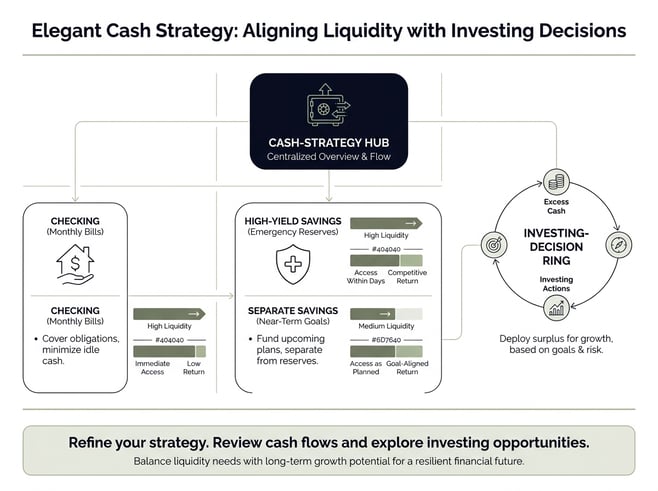
The "three to six months of expenses" guideline is a reasonable starting point, but it was never meant to be a finish line. For dual-income households trying to decide how much emergency savings to keep before investing more, the honest answer depends on what your income actually looks like under pressure, not just how many paychecks come in each month.
Two incomes can mean more stability, but they can also mean higher fixed costs, tighter benefit windows, and more complexity when something goes sideways. Even households with strong incomes need to map their cash flow carefully before assuming the cushion is sufficient. Fortitude's guidance on major life transitions addresses exactly this. The factors that actually shape your target are more specific than any generic rule accounts for:
The goal is a reserve sized to your real life, one that holds its ground when a disruption hits without keeping more cash idle than your situation actually requires.
Once you have a basic cash structure in place, the next step is sizing it for your actual household, not someone else's. A family with two kids, a mortgage, car payments, and private school tuition operates in a fundamentally different financial environment than a childless couple with low fixed costs. The CFPB's emergency fund guide notes that the right emergency fund size depends on your personal circumstances, not a blanket formula. Here is where that gets practical:
The CFP Board reinforces that while the 3-to-6-month rule is a reasonable starting point, the real target comes from understanding your own fixed obligations, income stability, and family commitments. For a household where multiple priorities compete for the same paycheck, that clarity is not optional. It is what keeps the rest of the plan from unraveling when life does what life does.

Deciding when to move extra cash into investments is less about timing the market and more about knowing what that money is actually for. When you invest extra money instead of keeping it in cash for short-term goals, the question you are really answering is: does this dollar have a long-term job, or does it need to stay close?
Extra money is ready to be invested once your emergency fund is solid and your near-term spending is already covered. If you are still building those reserves, putting money into a brokerage account first leaves you one unexpected bill away from selling at the wrong time.
Cash is a reasonable short-term home for money. It is a poor long-term one. If dollars sitting in savings have a timeline of five or more years, they are working far below their potential. Inertia is not a strategy, and "I might need it someday" is not the same as a near-term plan.
Before moving money into a taxable brokerage account, it is worth asking whether that dollar has a better home first. Maxing a 401(k) or IRA captures a tax deduction now. Completing a Roth conversion in a lower-income year can reduce your lifetime tax bill on retirement savings. Paying off a loan at 7% delivers a guaranteed after-tax return that most portfolios would envy. The sequence, which account gets the dollar and when, matters as much as the amount. That is why the invest-versus-cash question rarely has a clean answer without also looking at the tax picture.
Knowing how much cash to keep comes down to your specific life, not a universal rule. These answers address the practical questions that come up most often when people are trying to balance reserves, savings, and investing at the same time.
Your checking account should hold roughly one to two months of planned expenses, enough to cover bills without running dry. Everything beyond that earns more sitting in a high-yield savings account. Keeping those two buckets separate makes it easier to see what is truly available for emergencies versus what is just passing through.
Three to six months of essential expenses is the starting point, but the right number depends on how stable both incomes are. If either job is commission-based, seasonal, or in a field with longer rehire timelines, lean toward the higher end. Two paychecks lower risk only when both are reliable and expenses stay manageable.
Money that you will not need for at least five years is generally a better candidate for investing than sitting in savings. If a goal is closer, cash or a short-term bond option tends to be safer. The key question is not just timeline; it is whether your emergency fund is already in place and your near-term expenses are already covered.
It can. Cash that earns little while inflation rises quietly loses purchasing power over time. If you are holding large balances out of habit rather than for a specific near-term purpose, those dollars are not working as hard as they could. The goal is not to minimize cash, but to make sure every dollar has a clear job.
A good rule of thumb is to revisit your cash levels whenever something changes: a new job, a baby, a home purchase, or a shift in income. Life moves quickly in your 30s and 40s, and a cash strategy that made sense two years ago may not reflect where you are now. Regular plan reviews help you stay aligned rather than reactive.
The right cash target is not a universaI number, it is a decision that fits inside a broader plan, shaped by your income, obligations, tax situation, and goals. Your reserve size, retirement contributions, debt payoff plan, and investment choices are connected. When one shifts, the others need to adjust, and a cash strategy set in isolation tends to leave gaps that surface at the worst possible time.
Fortitude's holistic financial planning brings your reserves, investments, insurance, tax decisions, and retirement accounts into one coordinated picture, so a cash decision today does not quietly work against a tax decision next year or a distribution strategy in retirement. If your cash and investing decisions still feel like separate conversations, that separation has a cost. Book a consultation with our team and build a plan where every dollar knows its job.