


How Often Should You Rebalance Your Investment Portfolio in 2026?
How Often Should You Rebalance Your Investment Portfolio in 2026? A portfolio that felt well-balanced a year ago can drift further than most people ex...
When retirement is a few years away, a market drop is not just a number on a screen. A poorly timed decision now can affect your income, your taxes, and your withdrawal strategy for years to come. Research on sequence of returns risk shows that the timing of market losses matters as much as their size, especially in the years just before and after you stop working.
The real question during volatile markets is not whether to stay put or make changes. It is whether your current strategy still fits your retirement income needs, tax plan, withdrawal timing, and actual risk capacity. Those four things rarely align by accident, and a market drop is often the moment that makes the gaps visible. At Fortitude Wealth Planners, retirement planning connects all of them, so any adjustment is driven by your plan, not by the headlines.

Near-retirees should compare their current allocation with their actual withdrawal timeline, income sources, and cash reserves, not with how severe the market drop feels. A downturn often does not create a new problem. It makes an existing one visible. The question worth asking is not "how bad is this?" but "does my current strategy still support the retirement I am planning for?"
A declining market does not change what your portfolio was built to do. It shows you whether the risk level you accepted still feels manageable when it becomes real. If the drop is causing genuine anxiety about your retirement timeline, that is useful information. It means your allocation may have been more aggressive than your actual comfort level all along.
Withdrawals, retirement timing, and market tolerance need to work together. If you are three years from leaving work and your portfolio just dropped significantly, the question is whether you can still fund your first years of retirement without selling at a loss. That answer depends on your cash reserves, other income sources like Social Security or a pension, and how flexible your retirement date actually is.
Judging portfolio risk in isolation misses most of what matters. A near-retiree with one to two years of living expenses in cash, a pension covering half of monthly costs, and a flexible start date is in a very different position than someone with no cushion and a fixed retirement date. Fortitude's retirement planning approach looks at all of those factors together before recommending any allocation change, because the risk you can actually tolerate is a planning question, and the plan has to come first.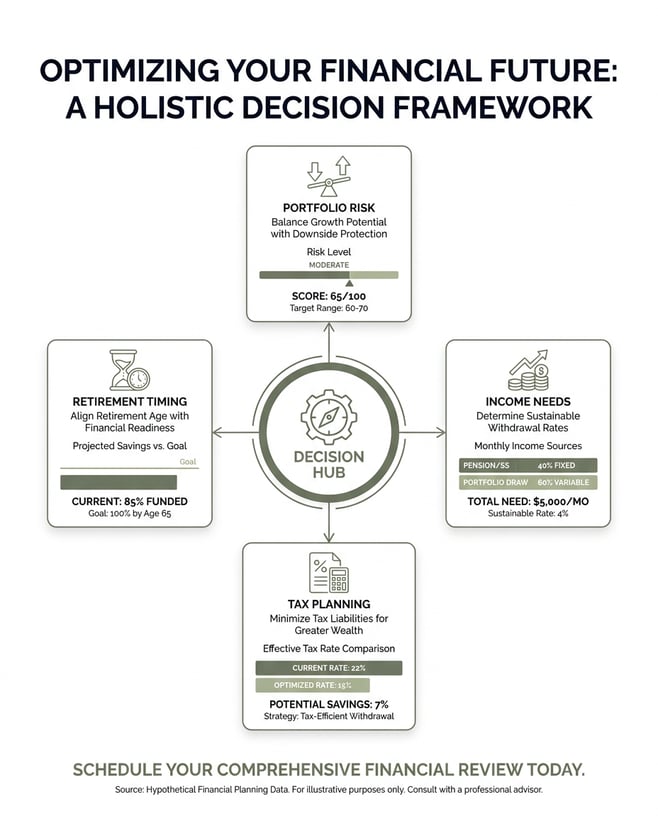
Is rebalancing your portfolio during market swings a disciplined move or an emotional reaction? It depends entirely on what is driving it. Rebalancing is a correction, not a prediction. It brings your portfolio back to the allocation you already decided made sense, not to a new one shaped by last week's market. Selling broadly because the news is alarming is a different thing, and the two can look similar in the moment.
The goal of a rebalancing process is to make the decision before volatility arrives, so when it does, you are following a plan rather than rewriting one.
Selling growth assets during a downturn to fund living expenses locks in losses at the worst time. Sequence-of-returns risk, the permanent drag on a portfolio caused by drawing it down while values are depressed, is most damaging in the years immediately before and after retirement. A better starting point is drawing from cash reserves or lower-volatility accounts first, giving the rest of the portfolio time to recover. Our volatile markets guidance covers this withdrawal-sequencing approach in more detail.
Selling growth assets during a downturn to fund living expenses locks in losses at the worst time. Sequence-of-returns risk, the permanent drag on a portfolio caused by drawing it down while values are depressed, is most damaging in the years immediately before and after retirement. A better starting point is drawing from cash reserves or lower-volatility accounts first, giving the rest of the portfolio time to recover. Our volatile markets guidance covers this withdrawal-sequencing approach in more detail.
A down market lowers account values, which means converting IRA dollars to a Roth costs less in taxes right now. If you're in a lower income year before retirement and Social Security, that window may be worth using. The move only makes sense when it fits the broader tax picture. As our tax planning resource outlines, Roth conversions interact with Social Security and Medicare premiums in ways that require careful coordination before acting.
Research from the CFA Institute shows that coordinating withdrawal strategy with investment decisions meaningfully reduces sequence risk. Pulling money from the wrong account, at the wrong time, in the wrong tax year can create complications that outlast the market dip that prompted the change. Near-retirees make more durable decisions when withdrawal timing, spending adjustments, and tax moves are reviewed as a set rather than handled one at a time.
When markets get choppy and retirement is close, the questions get more specific. Below are the most common market volatility retirement planning questions near-retirees face. Each one connecting portfolio choices to income, taxes, and timing.
Not automatically. A market downturn does not mean your current allocation is wrong. The right question is whether your portfolio still supports your planned withdrawal timeline and income needs. If it does, a reactive shift to more conservative holdings may reduce long-term growth without improving your actual retirement situation. A retirement planning review can answer this with your specific numbers in front of you.
When your portfolio is down and you are already drawing income, pulling less from investments temporarily can reduce the damage of selling at depressed prices. This is sometimes called sequence-of-returns risk. Pausing optional discretionary spending or drawing from cash reserves first can give the portfolio time to recover without forcing you to lock in losses. Learn more about withdrawal sequencing strategies in a down market.
Yes. When account balances are lower, a Roth conversion moves the same number of shares at a lower tax cost. If your income is also reduced that year, before Social Security or a pension starts, you may be able to convert more without moving into a higher tax bracket.That combination of depressed values and lower income is the window worth watching. A tax-efficient retirement income plan can identify whether that window is open for you.
Market volatility is not a reason to act. It is a reason to look closely at whether your plan still holds. The SEC's guidance is clear: allocation shifts should come from a planned strategy, not from short-term market movements. That means reviewing your retirement income needs, tax situation, insurance coverage, and estate considerations together before deciding anything needs to change.
A CFP Board review of 2025 market conditions drew the same conclusion: coordinated planning protects retirement outcomes in ways that reactive adjustments cannot. Near-retirees who navigate volatility well don't all make the same moves. What they share is that their moves were connected to a plan, not to a headline or a gut check. At Fortitude Wealth Planners, that starts with reviewing what you own, when you will need it, and what tax decisions are already in motion together. Vicki Beam's membership in Ed Slott's Elite IRA Advisor Group means IRA distribution strategy, Roth conversion timing, and investment decisions are reviewed as a unit, so any change made during a volatile period holds up long after markets settle.
If you are close to retirement and want to see whether your current strategy still fits, book a retirement planning consultation with Fortitude Wealth Planners.




.png?width=500&height=500&name=retired-couple-reviewing-financial-papers-home-office%20(1).png)