


Financial Planning for Major Life Transitions in 2026
Financial Planning for Major Life Transitions in 2026 Most people focus on the milestone itself: the wedding, the divorce, the job offer, or the retir...
Most growing families don't have a shortage of financial accounts. They have a shortage of connection between them. There's a 401(k) here, a 529 plan there, a life insurance policy that hasn't been reviewed since the first baby arrived, and a tax return that feels like a missed opportunity every April. The problem isn't the accounts. It's that no one is watching how all those decisions affect each other.
A wealth manager's real job is coordination. According to the CFP Board, qualified financial planners are expected to work across investments, retirement, tax, insurance, and estate planning as a connected whole, not as separate conversations. For a growing family, that connection is what makes individual decisions better because a college savings choice made without looking at retirement timing, or a life insurance decision made without reviewing estate documents, can quietly work against you even when it looks right on paper. Fortitude Wealth Planners brings that coordinated approach to families who want a plan that holds together across all of it.
Most people associate wealth managers with portfolios, but that picture is incomplete. What should a wealth manager help with besides investment management? A lot more than most families realize, and the difference matters most when life gets complicated.
Investment management is one piece of the picture. The part that most often gets missed, and where families tend to lose the most ground, is everything in between: the beneficiary designation that quietly redirects assets away from the estate plan, the Roth contribution made in a year when pre-tax would have saved more, the 529 balance that grew while retirement compounding stalled. None of those look like portfolio problems. That's exactly why they go unnoticed.
A growing family rarely runs short of financial goals. What's usually missing is the order: which one to fund first, in which account, and how this year's choice affects five years from now. The answer changes based on your tax bracket, your employer match, your kids' ages, and where you are in the income curve. A wealth manager holds that full picture and sequences decisions accordingly. At Fortitude Wealth Planners, our holistic financial planning process is built around exactly that kind of coordinated prioritization across retirement, college savings, insurance, and tax strategy.
The right move for your family depends on your income, your employer benefits, how many kids you have, your tax bracket, and your timeline. Tax planning alone changes which accounts you fund, in what order, and how much you keep after April. The CFP Board's tax planning guidance reinforces this: taxes are not a year-end checkbox but an ongoing piece of a coordinated plan. Getting those variables wrong in a single high-income year, whether it's the wrong account type, the wrong contribution order, or the wrong tax estimate, can mean paying more to the IRS than necessary. Personalized planning maps them together before April makes the decision for you.
Coordinating investments, taxes, and retirement planning means answering the real question underneath all those separate decisions: given your income, your tax situation this year, what your kids will need for college, and when you want to stop working, where does the next dollar actually go? That answer changes every year, and it changes depending on what else is happening across your financial life.
A few places where coordination makes a meaningful difference:
This is where integrated tax and investment planning does work that a portfolio alone cannot. Families gain the most clarity when one advisor is tracking how a contribution decision this November affects taxable income, next year's financial aid calculation, and a retirement projection ten years out, all at once, instead of handing each piece to a different person who never sees the others.
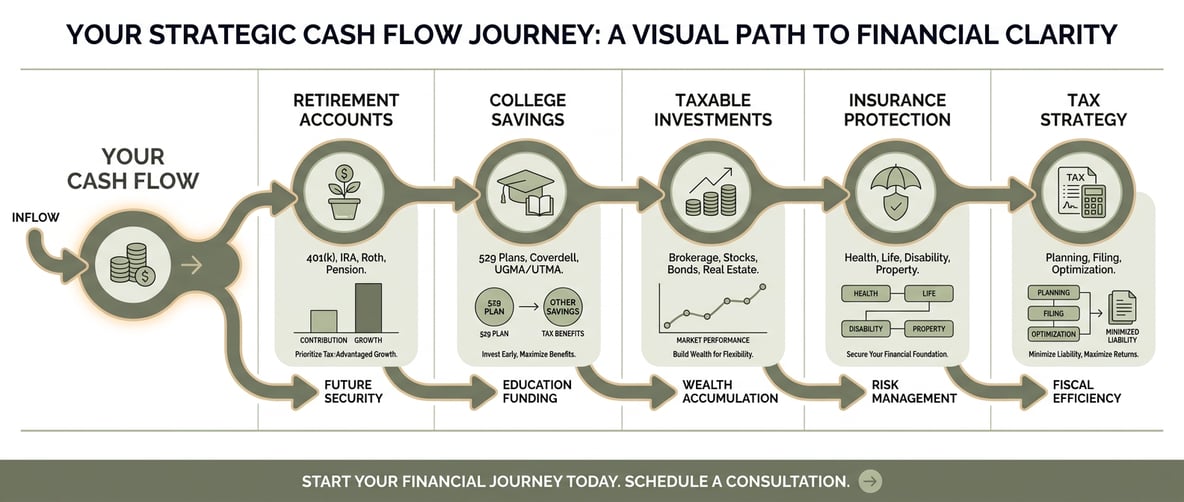
The need for this kind of guidance rarely announces itself in advance. It tends to show up at a life transition: a new baby, a bigger mortgage, a jump in income, stock compensation from a new employer, or a parent who suddenly needs more support. Each of those moments can expose gaps in old coverage, outdated beneficiary designations, or documents that were never signed in the first place. Waiting for things to feel "settled enough" usually means those gaps stay open longer than they should. Insurance and estate planning are not finishing touches for wealthy families. They are foundational decisions every growing family faces early.
A holistic wealth manager helps you work through these choices in context, not as a separate legal or insurance task checked off in isolation. Guardianship decisions, beneficiary designations, account titling, and basic documents like a will or healthcare directive all have a direct effect on the broader financial plan. So does the amount and type of life or disability coverage you carry relative to your income and debts. Reviewing wills, estate documents, and coverage together, as part of one coordinated plan, means those choices actually support your family's goals instead of sitting in a drawer until something forces the issue.
Growing families tend to arrive at wealth management with a mix of urgency and uncertainty. The questions below reflect what comes up most often when people realize their financial life has gotten more complex than any one account or advisor can handle alone.
The short answer is sequencing. A wealth manager maps out which goals need funding now, which can be phased in, and how much each one actually costs in today's dollars. Retirement planning and college savings do not have to compete when someone is coordinating them as part of the same plan. The IRS allows 529 contributions to grow tax-free for education, and a wealth manager helps you fund one without shortchanging the other.
No, and waiting until wealth feels "big enough" is one of the more costly assumptions families make. The decisions that matter most, like how to structure benefits at a new job, whether to pay down debt or invest, and how to title accounts with young children in the picture, happen long before portfolios get large. The CFPB notes that early planning habits shape retirement security more than late-stage corrections can. Getting coordinated advice early tends to prevent the gaps that are expensive to fix later.
At minimum, once a year. Life changes faster than most people update their plans. A raise, a second child, a new mortgage, or a job change can each shift the math on taxes, insurance coverage, and retirement contributions in ways that ripple through the rest of the plan. Fortitude builds in regular reviews so the plan stays current with your actual life, not last year's version of it.
The families who get the most from a wealth manager are rarely the ones with the largest portfolios. They are the ones who stopped letting their accounts operate as separate experiments. When retirement, taxes, insurance, and estate decisions are coordinated in one place, by someone who sees how each one affects the others, the plan does not just hold together on paper. It holds together when income changes, when kids arrive, when a job ends earlier than expected, and when it's finally time to make those decisions count.
Fortitude Wealth Planners connects those pieces: investments, tax planning, retirement, insurance, and estate considerations in one coordinated plan, with retirement and IRA planning informed by Vicki Beam's membership in Ed Slott's Elite IRA Advisor Group. If your family is ready to move from disconnected accounts to one plan that holds together, book a consultation with our team.



.png?width=500&height=500&name=retired-couple-reviewing-financial-papers-home-office%20(1).png)