


Year-End Tax Planning Checklist | Financial Moves Before December 31
Year-End Tax Planning Checklist | Financial Moves to Make Before December 31, 2026 One extra December distribution. An oversized Roth conversion. Poor...
You can own a well-diversified, low-cost portfolio and still leave significant money on the table at tax time. That happens when withdrawals, Roth decisions, and investment placement are each handled separately, without connecting them to the larger retirement picture. Research published in the Journal of Finance confirms that where you hold an investment matters as much as what you hold, because the same asset produces different after-tax results depending on the account type around it.
The tax-efficient investment strategies every investor should know work as a coordinated set of decisions: account location, IRA withdrawals, Roth opportunities, capital gains timing, and wealth transfer, rather than a checklist of isolated moves. They produce the most after-tax value when planned together, before retirement income begins and those choices become harder to unwind. Fortitude Wealth Planners brings together retirement, tax, and investment planning so each decision you make supports the rest of your plan, not just the account in front of you.

Where an investment sits matters as much as what it is. The IRS treats withdrawals, growth, and contributions differently across taxable accounts, traditional IRAs, and Roth accounts, which means the same bond fund or stock holding can produce meaningfully different after-tax results depending on the account holding it. Getting this placement right is one of the clearest ways to reduce the tax drag on a retirement portfolio before income distributions begin.
|
Account Type |
How It's Taxed |
Investments That Often Fit |
Key Planning Consideration |
|---|---|---|---|
|
Taxable Brokerage |
Contributions are after-tax; dividends and realized gains taxed annually |
Low-turnover index funds, tax-managed funds, municipal bonds |
Capital gains rates apply to long-term holdings; tax-loss harvesting opportunities arise here |
|
Traditional IRA / 401(k) |
Contributions may be pre-tax; growth is tax-deferred; withdrawals taxed as ordinary income |
Bonds, REITs, actively managed funds with higher turnover |
RMDs begin at age 73; large balances can push income into higher brackets in retirement |
|
Roth IRA / Roth 401(k) |
Contributions are after-tax; growth and qualified withdrawals are tax-free |
High-growth equities, assets with strong appreciation potential |
No RMDs during owner's lifetime; strong fit for legacy planning and bracket management |
The underlying principle is familiar enough: tax-inefficient assets such as bonds, REITs, and actively managed funds with high turnover often belong in sheltered accounts, while low-turnover equities can sit more comfortably in taxable accounts, where long-term capital gains rates apply. What often gets missed is that the right arrangement shifts over time. As Kitces research shows, placement decisions depend on time horizon, dividend yield, and turnover. That means the setup that made sense at 55 may not be the best configuration at 67, when RMDs are a few years out and your tax bracket is about to change. Account location is not a one-time default. It is a planning decision that should be revisited alongside your withdrawal sequence, projected tax bracket, and legacy goals. Fortitude's tax planning and investment approach treats it as part of the full retirement income picture, not something set once and left alone.
The most tax-efficient way to generate retirement income without pushing into a higher tax bracket is to coordinate withdrawals across your accounts year by year such as drawing from taxable, traditional, and Roth accounts in combination rather than emptying one before touching another. Most retirees have more flexibility here than they realize, and a few deliberate choices early in retirement can keep income at a manageable level for years to come.
The instinct to drain one account before touching another feels tidy. The tax result usually is not. Pull everything from a traditional IRA in years when Social Security and dividends are already flowing, and ordinary income rates can stack up faster than expected. This pushes you into a higher bracket on dollars that a different withdrawal sequence might have taxed at a lower rate, or not at all. Spreading withdrawals across taxable, traditional, and Roth accounts year by year keeps income in a more manageable range and preserves flexibility that disappears once RMDs are in full effect. Fortitude's retirement planning approach is built around this kind of year-by-year coordination.
Social Security adds a layer many people overlook. Once your combined income crosses certain thresholds, up to 85% of your benefit becomes taxable. That means a seemingly small IRA withdrawal can pull more of your Social Security into taxable territory than expected. Timing those withdrawals alongside your benefit start date is a year-by-year decision that affects how much you actually keep.
Required minimum distributions begin at age 73 for most retirement accounts. Once they start, you lose flexibility over how much taxable income you recognize each year. That is why the years just before RMDs often offer the clearest opportunity to shape your tax picture going forward. Proactive withdrawal planning in that window, as outlined in Fortitude's 2026 retirement strategies post, tends to matter far more than shaving a few basis points off an expense ratio.
The years between leaving full-time work and when required minimum distributions begin are often the most valuable planning window most people never use intentionally. Income tends to be lower, tax brackets are more manageable, and the decisions you make in this stretch can meaningfully change what your tax bill looks like for the next two decades.
Roth conversions work best in this window because you are moving money from a traditional IRA into a Roth account while your taxable income is still relatively low. You pay taxes on what you convert now, but future growth and qualified withdrawals from the Roth are tax-free. Once RMDs begin, your taxable income rises automatically each year whether you need the money or not, and the room to convert at a manageable cost shrinks. The arithmetic of Roth conversions shows that earlier action in lower-income years tends to produce better long-term outcomes, particularly when the converted funds stay invested and grow tax-free for years before they are needed.
Capital gains and dividend income add another layer. Each source of income affects where you land in your tax bracket, which in turn changes how much of a Roth conversion you can absorb before crossing into a higher rate. A few practical points to keep in mind:
Roth conversions and gain planning belong inside a coordinated strategy for managing how much of your retirement savings passes through the IRS before it reaches you or your family.
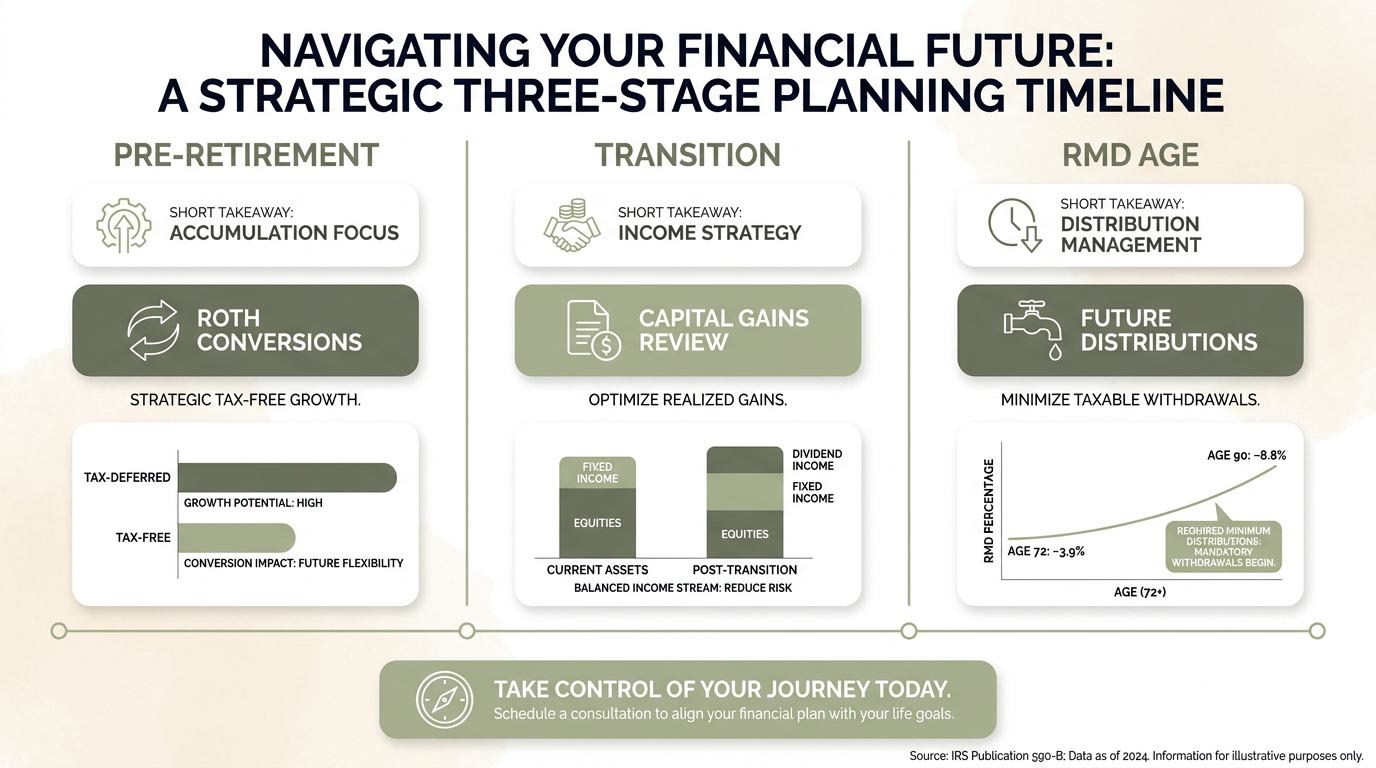
The closer you get to retirement, the more your income sources start to overlap in ways that matter for taxes. Capital gains, dividend income, and required minimum distributions each have their own rules, but they land on the same tax return. Understanding how they interact helps you avoid surprises that a single well-placed decision could have prevented.
RMDs are taxed as ordinary income, which means they can push you into a higher bracket. That higher bracket can then affect the rate you pay on capital gains and qualified dividends, since those rates also depend on your total taxable income. Coordinating all three in the same year requires planning before distributions are required.
Drawing from taxable accounts first can work well in early retirement when long-term gains qualify for lower rates. The risk is depleting assets that could otherwise benefit from a stepped-up basis at death, reducing the tax your heirs owe. The right sequence depends on your estate goals, not just your current bracket.
Qualified dividends are taxed at the same preferential rates as long-term capital gains, which are lower than ordinary income rates for most retirees. Keeping total income below certain thresholds can mean paying 0% on those dividends. That is a real planning opportunity, but only if you account for other income sources at the same time.
At minimum, once a year, and immediately after major life changes like a death in the family, a change in filing status, or a shift in legacy goals. Tax laws, income needs, and account balances all change over time. A strategy built for age 62 may not serve you well at 70 when RMDs are in full effect.
The decisions that shape your retirement tax bill are mostly made before retirement begins. Where assets sit, when you draw them down, what you convert and when; these are not investment questions alone. They are planning questions, and they compound in both directions. Connect them well and the coordination pays forward for decades. Leave them unconnected and each decision that looked fine in isolation can quietly constrain the next one.
That is the work Fortitude Wealth Planners does with clients approaching retirement. Vicki Beam's membership in Ed Slott's Elite IRA Advisor Group means our retirement and tax planning is grounded in deep knowledge of IRA rules, distribution strategy, and the real cost of decisions that cannot be undone. If you want to see how your accounts, income plan, and IRA strategy fit together as one coordinated picture, Tax Planning Strategies is a good place to start that conversation.