


Investing During Market Volatility | Stay the Course or Adjust?
Investing During Market Volatility | Stay the Course or Adjust? When retirement is a few years away, a market drop is not just a number on a screen. A...
You can love everyone in your family equally and still leave behind a financial mess. It happens more than most people expect: a beneficiary form filled out years ago quietly overrides what a will says, a surviving spouse inherits everything, and children from a prior marriage are left out entirely. Estate planning for blended families carries real risk when old documents, new relationships, and account titles all point in different directions.
Protecting everyone you love takes more than a will, it takes all of your documents working from the same current picture of your family. The real gap in most blended-family plans isn't missing paperwork; it's that the paperwork was never reviewed as a whole. A trust drafted by one attorney, retirement account beneficiary forms from a decade ago, and a life insurance policy left unchanged since a prior marriage may each make sense on their own, but together they can produce an outcome no one intended. The sections ahead walk through where these plans come apart and what it takes to hold them together. Fortitude Wealth Planners helps families build that kind of coordinated plan.

Estate planning for blended families works when the documents you sign, the accounts you hold, and the beneficiary forms you filed years ago all point in the same direction. That alignment rarely happens without deliberate planning.
Most people assume a will is the foundation of their estate plan. It is, but it cannot do all the work. A large share of assets, including retirement accounts, life insurance, and accounts with transfer-on-death designations, pass directly to whoever is named on those forms, regardless of what your will says. As AARP notes, this is one of the most common and costly oversights in blended-family planning. A will that looks complete on paper can still leave the wrong people inheriting the wrong things.
Blended families often carry two obligations that pull against each other: providing for a surviving spouse and preserving assets for children from a prior marriage. The natural instinct is to resolve that tension in a will. The problem is that a will governs only a fraction of what most people own. Retirement accounts and life insurance, often the largest assets in the estate, transfer directly to whoever is named on a beneficiary form, completely outside what any will says. According to the Financial Planning Association, account titling and beneficiary designations are among the most overlooked pressure points in blended-family situations, and getting them wrong is rarely reversible after the fact. A will is a starting point, not a solution.
Pay-on-death and transfer-on-death accounts are a clear example of where plans unravel. As ACTEC fellows explain, these designations bypass both wills and trusts entirely, which means a form you filled out before a remarriage can override every intention you documented since. That is why estate planning has to cover retirement accounts, insurance, and account ownership. Not just the legal documents alone. One outdated form can quietly undo what you spent years building.
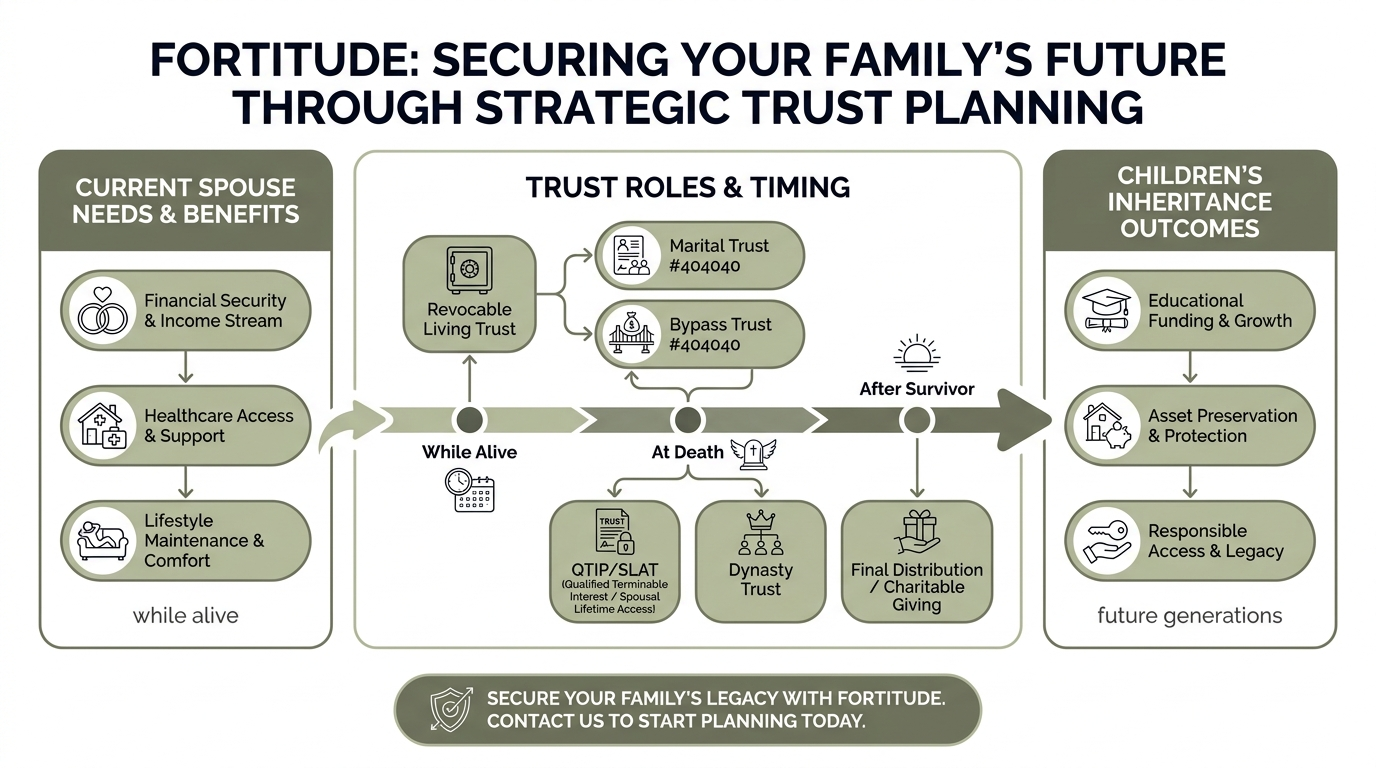
What type of trust can help protect both a current spouse and children from a prior marriage? A QTIP trust or credit shelter trust can do exactly that, and the mechanism is worth understanding. A QTIP trust legally separates the right to income from the right to principal: the surviving spouse receives income generated by the trust assets during their lifetime, while the underlying principal passes to your children from a prior relationship when the survivor dies. The surviving spouse is supported; the assets you intended for your children stay on track. The key is that the surviving spouse never has unlimited access to principal, which is precisely what keeps both goals intact at the same time.
What actually determines whether the plan works is the detail inside the trust document, not the label on it. A few things that need to be spelled out clearly:
The design decisions do not stop with the legal language. As Fortitude's estate planning resources point out, trust choices need to be coordinated with the rest of the financial picture, especially account types and tax consequences. A trust funded with pre-tax retirement assets, for example, can create a much heavier tax burden for beneficiaries than one funded with after-tax accounts. A trust that looks perfectly balanced on paper may create real problems if it holds the wrong assets or conflicts with how beneficiary designations are set up elsewhere.
That coordination is where trusts and wealth transfers planning does its most important work. A trust is a powerful tool, but it works best when it fits alongside retirement income needs, tax exposure, and the rest of your estate documents rather than sitting in a separate silo.
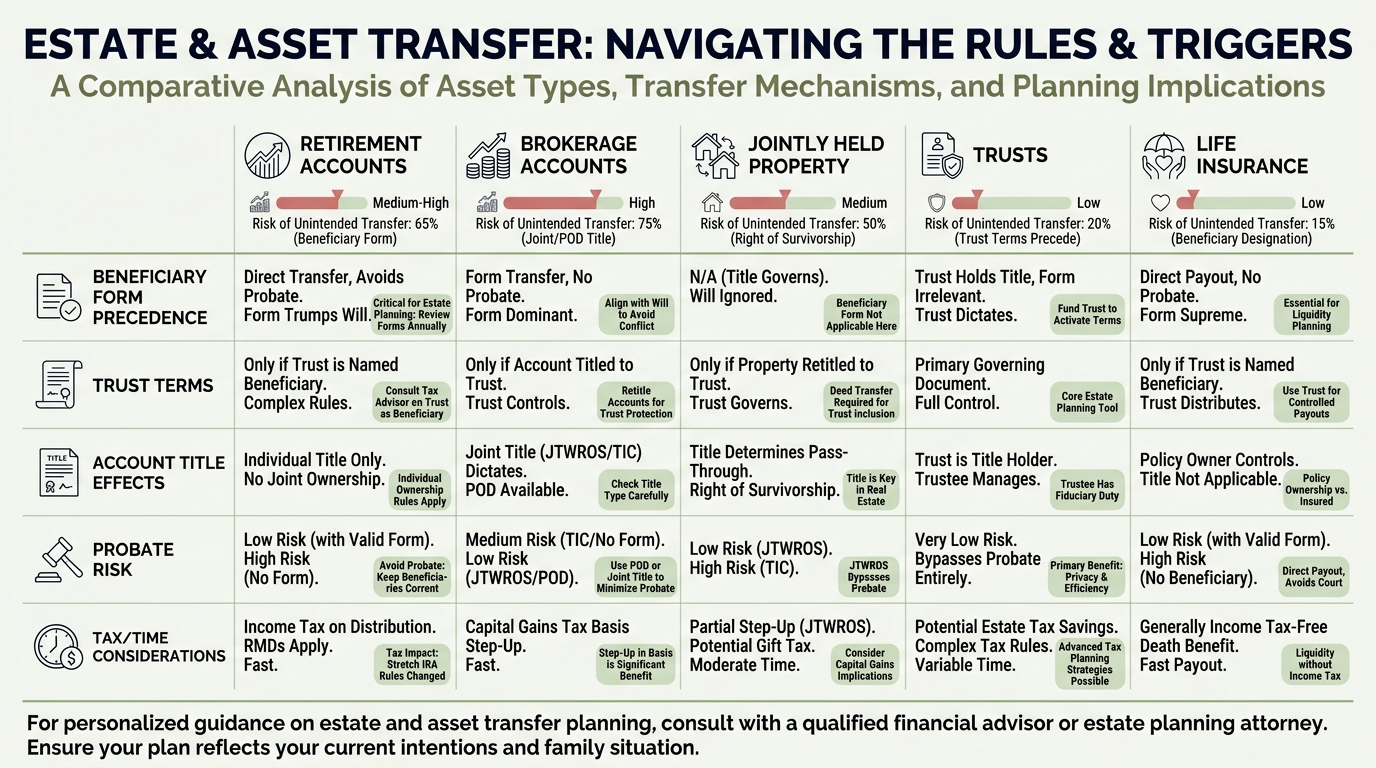
A carefully written will means very little if the beneficiary forms on your retirement accounts and life insurance point somewhere else. As the OPM confirms, beneficiary designations can supersede your will entirely, which means a designation filled out before a second marriage can quietly override every intention you set down later. How should beneficiary designations be updated in a blended family estate plan? Start by mapping how each asset type actually moves at death, that is where blended-family plans hold together or come apart.
|
Asset Type |
How It Transfers |
Common Blended-Family Risk |
Planning Move to Review |
|---|---|---|---|
|
Will/Trust Assets |
Through probate or trust distribution according to legal documents |
Will may conflict with separately titled assets; outdated trust terms may not reflect current family structure |
Review legal documents after every major life event; confirm asset titling aligns with trust or will instructions |
|
Retirement Accounts |
Directly to named beneficiary by contract, bypassing the will |
An ex-spouse or the wrong child remains on file after remarriage or divorce |
Review beneficiary forms line by line after marriage, divorce, births, deaths, or trust changes |
|
Inherited IRAs |
To named beneficiary; distribution rules depend on beneficiary category |
Spouse and non-spouse beneficiaries face different timelines and tax treatment under the 10-year rule, which can create unequal outcomes across children from different marriages |
Coordinate inherited IRA beneficiary decisions with overall tax and retirement income strategy; confirm any trust named meets IRS requirements to qualify as a designated beneficiary |
|
Life Insurance |
Directly to named beneficiary, outside probate |
Policy may be the largest liquid asset in the estate but is directed entirely by the beneficiary form, not the will |
Use life insurance strategically to balance inheritances when certain assets are earmarked for a current spouse or children from a prior marriage |
|
Transfer-on-Death or Joint Accounts |
To surviving joint owner or named TOD beneficiary at death |
Joint ownership passes the full account to the survivor automatically, which can cut children from a prior marriage out of the plan |
Review account titling alongside beneficiary forms; consider whether TOD designations or trust ownership better fits your family's goals |
Each of these asset types follows its own transfer rules, so a change in one area, like updating a trust, does not automatically update the beneficiary forms attached to your retirement accounts or insurance policies. Reviewing them together, as part of one coordinated wills and estate planning conversation, is what keeps your intentions intact across the full picture.
Blended families tend to surface questions that simpler family situations never raise. The answers below address the specific places where estate plans most often fall short when a second marriage, children from prior relationships, and decades of retirement savings are all in the picture at the same time.
Beneficiary forms should be reviewed after every major life event: marriage, divorce, a death in the family, or a change to your trust structure. These forms are legally binding contracts. Per IRS guidance, a named beneficiary on a retirement account will receive those assets regardless of what your will says. An outdated form can quietly override your best intentions.
Spouses and non-spouses face different rules when they inherit a retirement account, and those differences carry a real dollar cost in blended families. A surviving spouse can roll an inherited IRA into their own account and defer distributions for years. Children from a prior marriage are classified as non-spouse beneficiaries and must empty the account within ten years under the SECURE Act's 10-year rule, which can mean forcing large, taxable withdrawals during their peak earning years. The same retirement account dollar can be worth meaningfully less to a child than to a surviving spouse once taxes are factored in. Naming beneficiaries without accounting for that difference can create unintended inequity across your heirs, and it's exactly the kind of outcome that coordinated retirement and tax planning is designed to catch before it happens.
Yes, and it is often one of the cleaner tools available. If certain assets, like a family home or business interest, are meant to stay with children from a prior marriage, life insurance can provide the surviving spouse with comparable value without forcing a conflict over shared property. According to the Financial Planning Association, an irrevocable life insurance trust (ILIT) can also keep the death benefit out of your taxable estate while directing it exactly where you want it to go.
It can, but the trust has to be structured carefully. A trust named as beneficiary of a retirement account may limit the distribution options available to heirs, so the design needs to account for tax consequences alongside your legacy goals. This is precisely where having your estate documents and retirement accounts reviewed together, rather than separately, makes a meaningful difference.
Blended-family estate planning breaks down when documents are treated as separate tasks. A trust drafted without looking at your retirement accounts, a beneficiary form that hasn't been touched since your first marriage, an insurance policy pointing somewhere your will no longer intends. Each one is a gap waiting to matter. Alignment across every document is what makes your plan actually work.
The decisions that protect a current spouse while preserving something meaningful for children from a prior marriage don't live in one form or one account. They live in how your trusts and wealth transfers strategy connects to your tax exposure, your retirement income timeline, and your insurance coverage. A beneficiary form from a prior marriage can quietly undo a trust drafted last year. An IRA left to the wrong beneficiary category can cost heirs tens of thousands in taxes that didn't have to happen. These aren't edge cases, they're what results when good intentions are spread across documents no one has reviewed together. Fortitude Wealth Planners works with blended families to close those gaps: reviewing each asset alongside the full plan so your wishes hold up in real life, not just on paper.